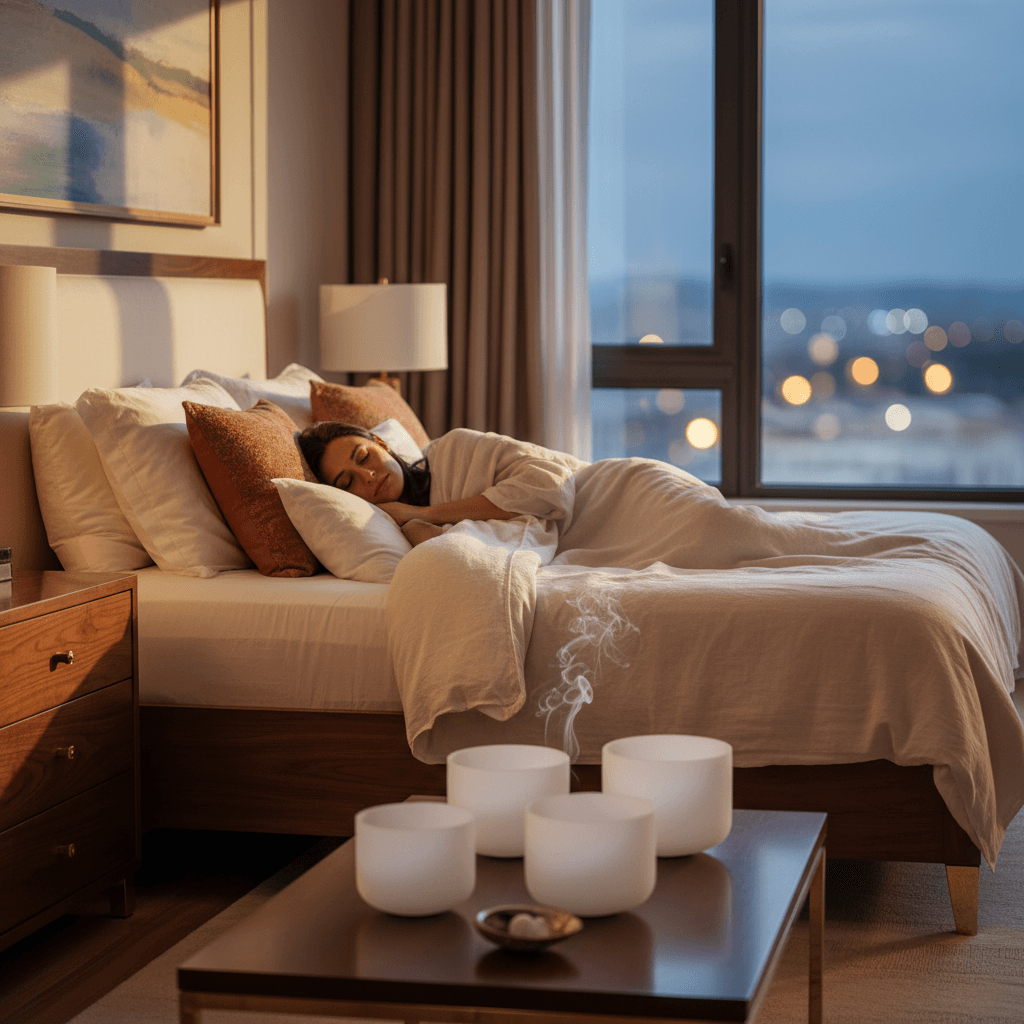
Sleep Stage Transitions: Smooth Cycling Through Sound
Key Insights
Discover the science of sleep architecture and how specific sound frequencies can support seamless transitions between sleep stages, reducing micro-arousals and enhancing restorative rest.
Have you ever slept for a full eight hours yet woken up feeling as if you’ve hardly rested at all? This common experience highlights a crucial distinction: the quantity of your sleep is only part of the story. The true measure of restorative rest lies in its quality—specifically, in the seamless, uninterrupted journey your brain and body take through the various stages of sleep.
This journey, known as the sleep cycle, is a delicate and complex ballet. Each night, you cycle through periods of light sleep, deep physical restoration, and active mental processing. However, these transitions are fragile. Even subtle environmental sounds can disrupt this natural rhythm, leading to fragmented sleep that undermines your daytime energy, cognitive clarity, and emotional equilibrium. This article explores the intricate science of sleep stage transitions and reveals how a curated soundscape may be one of the most powerful, non-invasive tools for supporting this fundamental pillar of your wellbeing.
The Intricate Ballet of Your Brain at Night
To understand how to improve sleep, we must first appreciate its architecture. Sleep is not a monolithic state of unconsciousness but a dynamic, highly structured process. A well-rested night is the result of successfully navigating multiple sleep cycles, each with its own vital purpose.
Understanding the Sleep Cycle: More Than Just On and Off
Throughout the night, your brain cycles through two main types of sleep: Non-Rapid Eye Movement (NREM) and Rapid Eye Movement (REM). A complete cycle lasts approximately 90 minutes and repeats several times.
- NREM Stage 1 (N1): The brief transition from wakefulness to sleep. Your breathing and heart rate begin to slow.
- NREM Stage 2 (N2): Light sleep. You spend the most time here. Your body temperature drops, and brain waves slow further, preparing you for deeper stages.
- NREM Stage 3 (N3): Deep, slow-wave sleep. This is the most physically restorative stage, crucial for cellular repair, growth hormone release, and immune system function.
- REM Sleep: The stage most associated with dreaming. Your brain activity mirrors that of being awake. REM sleep is essential for memory consolidation, emotional processing, and learning.
For optimal health, completing four to six of these cycles uninterrupted is key. The transitions between them are as important as the stages themselves.
The Fragility of Transition: What Are Micro-Arousals?
Research from sleep science highlights a major saboteur of sleep quality: micro-arousals. These are brief, often unnoticed surges in alertness triggered by external stimuli, particularly environmental noise. A study published in Sleep Medicine confirmed that even subtle noise fluctuations can interfere with the consolidation of the sleep cycle.
When a disruptive sound occurs during a delicate transition—say, from light sleep into deep sleep—it can trigger a micro-arousal that effectively resets the process. Your body is forced back into a lighter stage, reducing the total time spent in the most beneficial N3 and REM phases. These interruptions accumulate over the night, leading to a feeling of fatigue and under-performance the next day, even if you were technically "asleep" the whole time.
Your Body's Own Soundtrack: Respiratory Clues to Sleep Depth
Fascinatingly, our bodies produce their own sound-based indicators of sleep depth. A recent study in PMC demonstrated that respiratory sounds carry significant information about our sleep architecture. Researchers found they could accurately estimate which sleep stage a person was in simply by analyzing their breathing patterns from audio recordings.
- Deep N3 Sleep: Associated with slower, more regular, and rhythmic breathing.
- REM Sleep & Wakefulness: Characterized by faster, more irregular breathing.
This establishes a profound physiological link: the state of our nervous system is directly reflected in the sounds we produce. This also suggests that if our internal soundscape is tied to sleep depth, a controlled, external soundscape could be used to gently guide and stabilize it.
Sleep as a Dynamic System: Finding Stability
Emerging research conceptualizes sleep stages as attractor states within a complex system. Think of deep sleep as a calm, stable valley. A healthy sleeper can easily enter this valley and remain there. Disruptive noise acts like a constant wind, preventing you from settling and repeatedly pushing you back up to the unstable peaks of light sleep or wakefulness.
The goal of a wellness practice focused on sleep is to create an environment that minimizes these disruptive forces, allowing your brain to naturally find and settle into these stable, restorative valleys.
The true art of sound wellness lies not in a static playlist, but in a responsive dialogue with the nervous system, where sound creates a space for the body to remember its own natural rhythm of rest.
From Theory to Tranquility: The Role of Therapeutic Sound
Understanding the science behind sleep transitions allows us to see how therapeutic sound can be a powerful tool for enhancing sleep quality. It’s not about simply blocking out noise, but about creating an intentional auditory environment that actively supports your body's natural processes.
Creating a Consistent Auditory Anchor
The first and most fundamental role of a sound-based wellness practice is to provide a stable auditory anchor. A consistent, gentle soundscape—like that produced by singing bowls or ambient tones—can effectively mask the sudden, unpredictable noises that cause micro-arousals. This sonic blanket helps to smooth out the auditory environment, reducing the jarring fluctuations that can knock you out of deeper sleep stages.
The Principle of Entrainment: Guiding Brainwave Activity
A more profound mechanism at play is brainwave entrainment. This is a principle where the brain’s own electrical cycles, or brainwaves, tend to synchronize with the rhythm of external sensory input, such as sound. Different sleep stages are characterized by dominant brainwave frequencies:
- Theta waves (4-8 Hz): Associated with light sleep, deep meditation, and the onset of sleep.
- Delta waves (less than 4 Hz): The signature of deep, restorative N3 sleep.
Research, including a meta-narrative review in PMC, has explored how music embedded with specific frequencies, like binaural beats, may encourage the brain to produce more theta and delta waves, thereby promoting relaxation and facilitating the transition into deeper sleep. An audio pillow study even showed that participants exposed to these sounds experienced shorter sleep onset latency.
A 'Closed-Loop' Concept for Relaxation
Modern sleep technology is moving towards real-time, adaptive systems. Some research has highlighted wearable devices that infer sleep stages in real-time and deliver targeted auditory stimulation to enhance sleep quality. This "closed-loop" concept—where the intervention responds to the body's current state—is the pinnacle of personalized support.
In a professional sound bath setting, a skilled practitioner creates a similar, albeit more organic, closed-loop experience. By observing a client's breathing and other subtle physical cues, the practitioner can intuitively adjust the soundscape, using specific tones and rhythms to deepen relaxation and guide the nervous system toward a state of profound rest.
The Soul Art Approach: Curated Sound for Restorative Sleep
At Soul Art, we integrate these scientific principles into a deeply sensorial and personalized wellness experience. Founder Larissa Steinbach has developed a unique methodology that goes beyond a standard sound bath, focusing specifically on creating the optimal conditions for the nervous system to relax and reset.
Our approach is founded on the art of sound curation. We understand that not all sounds are created equal. The selection, combination, and sequencing of instruments are intentionally designed to mirror the natural progression of a sleep cycle. A session at our Dubai studio might begin with the complex, grounding overtones of Himalayan singing bowls to quiet the analytical mind and ease the transition away from wakefulness.
As the session progresses, Larissa may introduce the pure, resonant frequencies of quartz crystal bowls, which are often associated with encouraging the theta and delta brainwave states necessary for deep rest. The entire experience is a seamless flow, a continuous soundscape free of abrupt changes that could trigger an arousal response. The Soul Art method is a bespoke journey, creating a stable, nurturing sonic environment where your body can disengage from its alert state and effortlessly cycle through the stages of restorative sleep.
Cultivating Smoother Sleep Transitions at Home
While a professional sound session offers a uniquely immersive experience, you can begin to apply these principles at home to support better sleep hygiene. The goal is to create consistency and signal to your body that it is time for deep rest.
Here are a few practical steps you can implement today:
- Establish an Auditory Wind-Down Ritual: Dedicate 15-20 minutes before bed to listening to calming, non-lyrical music, ambient soundscapes, or specific frequency tracks. This helps detach from the day's stressors and signals the start of your sleep process.
- Consider a Consistent Sound Mask: If your environment is prone to unpredictable noises, using a white, pink, or brown noise generator can create a stable auditory backdrop. This masks sudden sounds that might otherwise disrupt your sleep stage transitions.
- Mind Your Breath and Its Rhythm: Drawing from the research linking respiration to sleep stages, practice a simple breathing exercise before sleep. A technique like the 4-7-8 method (inhale for 4, hold for 7, exhale for 8) can slow your respiratory rate, a key physiological cue for initiating rest.
- Explore a Professional Sound Bath: To truly understand how your unique nervous system responds to sound, consider a professional sound wellness session. It's an opportunity to experience deep, guided relaxation and discover the frequencies that feel most restorative for you.
In Summary: Your Pathway to Deeper, More Connected Sleep
The quality of your sleep is not determined by hours alone, but by the smooth, uninterrupted cycling through its essential stages. Modern life, with its constant auditory disruptions, often fragments this delicate process through micro-arousals, leaving us tired and depleted.
Scientific evidence increasingly suggests that a curated sound environment is a powerful tool for protecting these fragile transitions. By masking disruptive noise, encouraging relaxing brainwave states through entrainment, and providing a stable anchor for the nervous system, sound wellness practices can profoundly support the body's innate ability to rest and repair.
At Soul Art, we are dedicated to creating these optimal conditions for restoration. We invite you to explore how a personalized sound experience can help you navigate your nightly journey with greater ease, leading to more energized days and a deeper sense of overall wellbeing.
Bookings Coming Soon
Soul Art is still in preparation. Session details and booking will be published here after launch.
Coming Soon
Related Articles
Fan Noise and Sleep: Unmasking the Science Behind White Noise Machines for Deeper Rest
Polyphasic Sleep & Sound Healing: Navigating Restorative Rhythms
REM Rebound: Mastering the Art of Recovering Lost Dream Sleep