The Insula: Your Brain's Bridge Between Sound and Emotion
Key Insights
Discover the insula, the brain region that translates sound into emotion. Learn how Soul Art's sound wellness practices can support your emotional wellbeing and self-awareness.
Unlocking Your Emotional World Through Sound
Have you ever felt a sudden wave of calm wash over you while listening to the rain? Or experienced a shiver down your spine from a single, resonant musical note? These profound physical and emotional reactions to sound are not mere happenstance; they are the result of intricate neurological processes orchestrated deep within your brain. At the heart of this experience lies a small, often-overlooked region called the insula.
The insula acts as the brain’s master conductor, translating the raw data of sound into the rich tapestry of human emotion. It is the bridge between what you hear with your ears and what you feel in your body and soul. Understanding the insula's role is fundamental to appreciating how targeted sound frequencies can be a powerful tool for stress management, emotional regulation, and deepening self-awareness.
In this article, we will journey into this fascinating part of the brain. We will explore the science of how the insula processes sound, connect this knowledge to the tangible experiences of sound wellness, and reveal how the curated approach at Soul Art Dubai harnesses these principles to support your holistic wellbeing.
The Science Explained: Meet Your Insular Cortex
The insular cortex, or insula, is a complex brain region tucked away deep within the lateral sulcus, which separates the temporal lobe from the frontal and parietal lobes. For a long time, its deep location made it difficult to study, but modern neuroimaging has revealed its critical role as a central hub for integrating sensory information with our internal bodily state.
What is the Insula? The Brain's Hidden Island
Think of the insula as a sophisticated interface. It receives two main types of information:
- Exteroceptive Information: Data from the outside world, gathered by our five senses. In our context, this is primarily the auditory information from sound waves.
- Interoceptive Information: Signals from inside our body, such as our heartbeat, breathing rate, and gut feelings. This is our awareness of our internal physiological state.
Research published in journals like NeuroImage and studies from the National Library of Medicine highlight that the insula’s unique function is to merge these two streams of information. It gives rise to what scientists call our "sentient self," creating the subjective awareness of our feelings and bodily sensations. This integration is what allows a sound to feel calm, jarring, or joyful.
The insula acts as an active interface integrating external and internal information, giving rise to ‘bodily’ and ‘sentient self’ sensations, which drive emotions and guide decisions.
The Insula's Two-Part Harmony: Anterior vs. Posterior
The insula isn't a single, uniform structure. It's broadly divided into two key parts, each with a distinct role in processing sound and emotion:
-
The Posterior Insula: This area is connected to primary sensory regions, like the auditory cortex. When you hear a sound, the posterior insula processes its physical properties—its pitch, volume, and timbre. It answers the question, "What am I hearing?" It deals with the presented sound.
-
The Anterior Insula: This region is more involved with the subjective, conscious experience of emotion. It receives the processed sensory data from the posterior insula and integrates it with your internal state via strong connections with the amygdala (the brain's emotion and fear center). The anterior insula answers the question, "How do I feel about what I'm hearing?" It governs the perceived emotion.
A 2022 study in PubMed using iEEG recordings beautifully demonstrated this. Researchers found that activity in the posterior insula was tied to the presented emotion in a speaker's voice, while activity in the anterior insula and amygdala was driven by the perceived emotion of the listener. This distinction is crucial for sound wellness, as it shows how a sound's physical properties can be used to guide a listener's subjective emotional experience.
A Network of Feeling: The Insula's Connections
The insula does not work in isolation. It is a key node in several important brain networks, most notably the salience network. This network helps your brain decide what deserves your attention. The anterior insula, in particular, detects emotionally relevant stimuli—like a sudden sound or a soothing frequency—and signals other brain areas to respond accordingly.
Dysfunction in this network has been linked to various conditions. For instance, studies on misophonia (a strong aversion to specific sounds) show hyper-connectivity in the anterior insula. Conversely, practices that enhance interoceptive awareness, such as meditation and sound baths, are suggested to improve insular function, which may support better emotional regulation and a stronger connection between mind and body.
How It Works in Practice: From Brain Waves to Body Sensations
Understanding the neuroscience is one thing, but feeling its effects is another. During a sound wellness session, these complex brain processes translate into tangible, deeply personal experiences. The goal is to use sound as a tool to guide the insula’s integrative process towards a state of balance and calm.
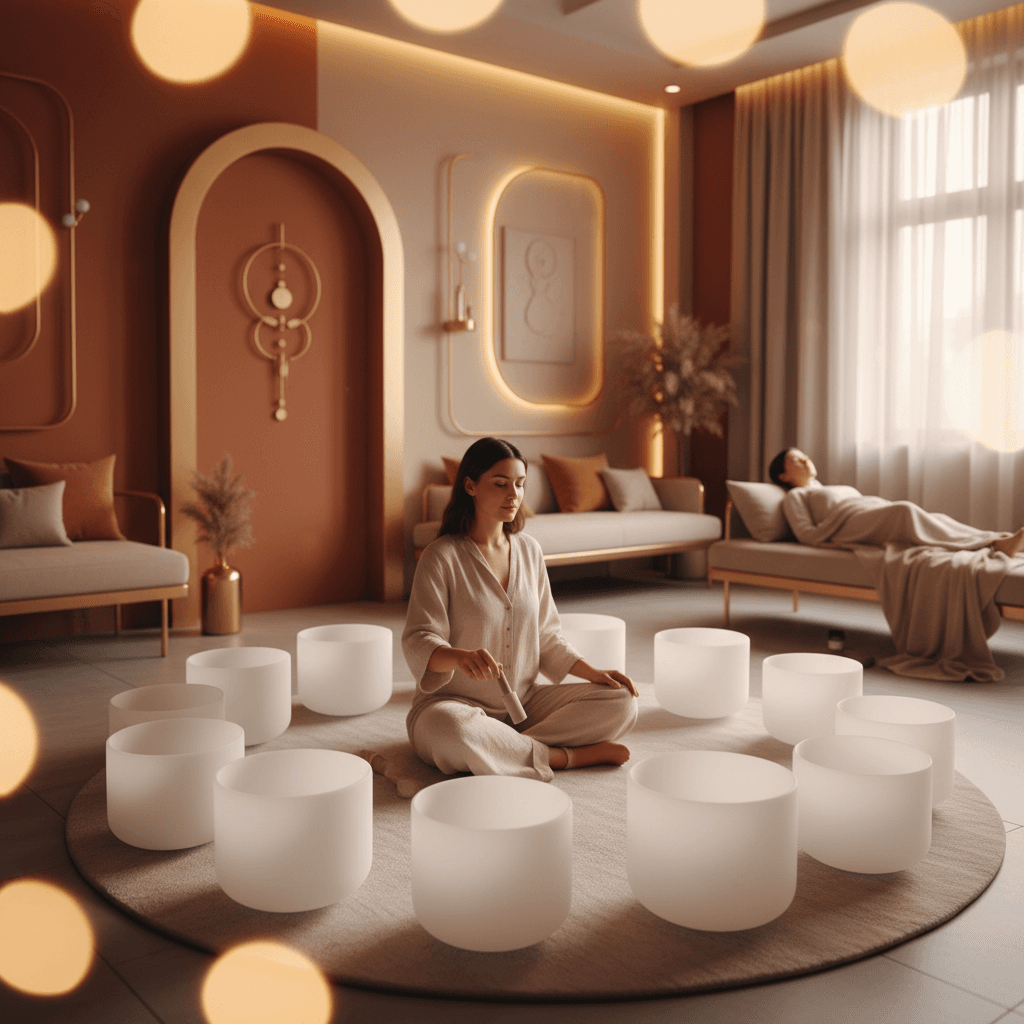
Imagine lying comfortably in a tranquil space. The session begins with the gentle, pure tone of a crystal singing bowl. This auditory stimulus travels to your brain. First, your posterior insula registers the acoustic properties: a clear, high-frequency sine wave. It is simply raw data.
Simultaneously, the sound vibrations travel through your body, a phenomenon known as vibroacoustic stimulation. Your interoceptive network picks up on these subtle physical sensations—a slight tingling in your chest, a feeling of resonance in your bones.
Now, the anterior insula gets to work. It takes the pure acoustic data from the posterior insula and combines it with the calming physical sensations being reported by your body. It cross-references this with your current emotional state and memories. The result? Your anterior insula and amygdala interpret this integrated signal as "safe," "relaxing," and "peaceful." This conscious perception triggers a cascade of physiological responses: your breathing may slow, your heart rate can decrease, and your nervous system may shift from a "fight-or-flight" state to a "rest-and-digest" state.
As the session progresses with different instruments like gongs and chimes, this process repeats. Each sound is an invitation for your insula to bridge your inner and outer worlds, fostering a profound state of embodied awareness where you are not just hearing the sound, but feeling it as a holistic experience.
The Soul Art Approach
At Soul Art, this scientific understanding is the bedrock of our practice. As the founder, I, Larissa Steinbach, have designed our sessions not as a random collection of pleasant noises, but as a precisely curated journey for your nervous system. We intentionally select instruments and frequencies that are known to engage the insula in a way that supports deep relaxation and emotional release.
Our method is unique because we focus on creating a rich sensory environment that encourages the anterior insula to generate positive subjective experiences. We achieve this through several key principles:
- Harmonic Coherence: We use instruments like Himalayan singing bowls and planetary gongs that produce complex, harmonically rich tones. These sounds are less likely to be perceived as alarming by the amygdala and may promote a state of focused attention.
- Dynamic Progression: A session is structured like a story, with a beginning, middle, and end. We gently guide your brain from active Beta wave states to more relaxed Alpha and Theta states, allowing your salience network to gradually shift its focus inward.
- Interoceptive Focus: Through gentle guidance, we encourage you to pay attention to the physical sensations of the sound. This practice of mindful listening strengthens the insula's ability to process internal signals, which research suggests is associated with improved emotional regulation.
The Soul Art experience is a practical application of neuro-affective science, designed to help your insula do what it does best: create a harmonious connection between your mind, your body, and the world around you.
Your Next Steps: Tuning Into Your Insula Today
You don't have to wait for a professional session to begin exploring the power of sound for emotional wellbeing. You can start strengthening your insula's ability to process sound and emotion with these simple, actionable practices:
- Mindful Music Listening: Choose a piece of instrumental music you enjoy. Close your eyes and listen without distractions. Instead of just hearing the melody, try to notice the physical sensations it creates in your body. Does your chest feel open? Do you feel a sense of lightness?
- Practice Humming or Chanting: The act of creating your own sound is a powerful form of interoception. Hum a single, low tone for a few minutes. Pay close attention to the vibrations in your throat, chest, and head. This directly engages the insula with both auditory and physical feedback.
- Listen to Nature Soundscapes: Find a high-quality recording of rain, ocean waves, or forest sounds. These complex, non-linear sounds are often perceived as non-threatening and calming, providing a gentle stimulus for your auditory and emotional processing centers.
- Embrace Silence: In our noisy world, moments of quiet can be profound. Sit in silence for five minutes and simply notice the ambient sounds you usually filter out. This practice can help reset your auditory system and make you more sensitive to the nuances of sound.
These simple exercises can help you build a stronger mind-body connection. When you're ready to explore this practice on a deeper level, a professionally guided session at Soul Art can provide a supportive and immersive environment for profound relaxation and self-discovery.
In Summary
The insula is a remarkable and essential part of your brain, acting as the bridge between the external world of sound and your internal world of feeling. By integrating auditory information with bodily sensations, it gives rise to our conscious emotional experiences. The posterior insula processes the "what," while the anterior insula determines the "how I feel about it."
Understanding this relationship empowers us to use sound intentionally as a tool for wellness. Through practices like mindful listening and sound baths, we can positively influence this neural pathway, potentially supporting emotional regulation, reducing stress, and enhancing our sense of self-awareness. At Soul Art, we are dedicated to applying this knowledge to guide you on a transformative journey of sound and sensation.
Bookings Coming Soon
Soul Art is still in preparation. Session details and booking will be published here after launch.
Coming Soon
Related Articles

Cluster Headaches: Unveiling Pain and the Promise of Frequencies in Wellness

Epilepsy & Sound: Safety, Serenity, and Emerging Wellness Paths

Mastering Focus: Analytical Listening & Brain Engagement at Soul Art