The Silent Architects: How Sound Waves Shape Our Wellbeing

Key Insights
Explore the science of sound propagation through different media and its profound impact on holistic wellbeing, as practiced by Larissa Steinbach at Soul Art Dubai.
Have you ever wondered why the gentle hum of a singing bowl can resonate deep within your bones, or why sounds travel so differently through air compared to water? The journey of sound, from its source to its ultimate impact, is a fascinating interplay of physics and matter. Understanding this journey is not merely an academic exercise; it unlocks a profound appreciation for how sound can shape our experiences and influence our overall wellbeing.
At Soul Art, Dubai's premier sound wellness studio, we delve into the intricate science of sound propagation to craft experiences that resonate deeply with your nervous system. Larissa Steinbach, our founder, has dedicated her practice to harnessing these scientific principles. By understanding how sound waves traverse different media, we can create environments that foster deep relaxation, stress management, and a unique sense of inner harmony.
This article will explore the scientifically grounded principles of how sound propagates through various materials, from the air around us to the very cells within our bodies. We will uncover why these differences matter and how this knowledge forms the bedrock of transformative sound wellness practices. Prepare to discover the hidden power of vibration and its potential to revitalize your entire being.
The Fundamental Physics of Sound Waves
Sound is not an ethereal concept; it is a tangible, mechanical wave that requires a medium to travel. Unlike light, which can travel through the vacuum of space, sound relies on the vibration and collision of particles. These vibrations propagate as longitudinal waves, consisting of alternating regions of compressions (where particles are close together) and rarefactions (where particles are spread apart).
The speed at which sound travels through a medium is determined by the medium's inherent properties. This speed, often denoted as 'c', is directly related to the wave's frequency ('f') and wavelength ('λ') by the fundamental equation c = fλ. When a sound wave moves from one medium to another, its speed and wavelength typically change, while its frequency usually remains constant.
The Role of Medium: Gases, Liquids, and Solids
The structural arrangement and bonding strength of particles within a medium are the primary determinants of how quickly sound propagates. This explains the significant differences observed in gases, liquids, and solids. Generally, closer and more rigidly connected particles transmit sound faster and more efficiently.
In gases, such as the air we breathe, particles are widely spaced and weakly bonded, leading to infrequent collisions. Consequently, it takes longer for vibrations to transfer between particles, resulting in the slowest speed of sound. For instance, sound travels at approximately 343 meters per second in dry air at room temperature.
Liquids, like water, possess particles that are much closer together than in gases, allowing for more frequent and direct interactions. Although liquid particles can move past each other, their proximity facilitates faster transmission of vibrations. Sound typically travels much faster in water, around 1500 meters per second, compared to air.
Solids exhibit the fastest sound propagation speeds due to their tightly packed and strongly bonded particles. The rigid structure of solids allows vibrations to transfer almost instantaneously from one particle to the next. For example, sound can travel over 5000 meters per second in steel, highlighting the profound effect of material structure on acoustic transmission.
Density, Elasticity, and Acoustic Impedance
Beyond the state of matter, two crucial physical properties of a medium significantly influence sound speed: density and elasticity. Density refers to the mass per unit volume of a material. Elasticity, or stiffness, measures a material's resistance to deformation and its ability to return to its original shape after being disturbed. A medium with high elasticity and low density generally allows sound to travel faster.
However, it's not simply about density alone. While denser materials can transmit sound faster if they are also highly elastic, a very dense material with low elasticity (like a thick, gooey liquid) might transmit sound more slowly. The interplay between these two properties is critical. The resistance a medium offers to the propagation of sound waves is quantified by its specific acoustical impedance, denoted as z.
Specific acoustical impedance is defined as the product of the medium's density (ρ0) and the speed of sound within it (c), so z = ρ0c. This value is crucial because it dictates how much sound energy is transmitted versus reflected when a wave encounters an interface between two different media. A significant mismatch in acoustic impedance between two media will lead to considerable reflection of sound waves.
Refraction, Reflection, and Attenuation
When sound waves encounter an interface between two media with different acoustic properties, several phenomena can occur. Refraction is the bending of sound waves as they pass from one medium to another, or even through layers within the same medium that have varying properties. This bending follows Snell's Law and is observed, for instance, when sound travels through air or water with temperature gradients. Warm air or water, being less dense, changes the speed of sound, causing waves to refract and potentially creating "guided wave" phenomena, where sound energy is reinforced within certain layers.
Reflection occurs when sound waves bounce off an interface, much like light reflecting off a mirror. This happens when there is a significant mismatch in acoustic impedance between the two media. Part of the sound energy is reflected back, while the remaining part is transmitted into the new medium. The greater the impedance difference, the stronger the reflection.
Attenuation describes the gradual loss of sound energy as it travels through a medium. This energy loss is due to absorption by the medium and scattering of the sound waves. Higher frequency sounds tend to attenuate more rapidly than lower frequency sounds over the same distance. The transmission distance also plays a role, with sound pressure levels decreasing as the wave travels further.
How It Works in Practice: The Body as a Medium
Our understanding of sound propagation gains profound significance when we consider the human body as a complex and dynamic medium. Far from being a static entity, the body is a vibrant landscape of different materials—water, bone, muscle, and air—each interacting uniquely with sound waves. This intricate internal architecture allows sound to travel, transform, and influence us on a cellular level.
Cellular Communication and Resonance
The human body is approximately 60% water, making it an excellent conductor for sound waves, similar to a liquid medium. However, it also contains denser structures like bone (solid medium) and air-filled spaces like the lungs (gaseous medium). This multi-layered composition means that sound waves experience a continuous process of refraction, reflection, and transmission as they traverse various tissues and organs.
Scientific research suggests that every part of our body vibrates at its own unique "sound signature" or resonance frequency. Quantum physics even describes the universe as vibrating strings of energy, and our cells are no exception. They communicate incessantly through a "sound language," a concept that science is only now beginning to fully codify.
When parts of the body are under stress or experiencing imbalance, their natural vibrational patterns may become "detuned." This concept aligns with the understanding that disrupted physiological states can alter cellular mechanics and communication. Introducing coherent, harmonizing sound waves through specific wellness practices may support the body in returning to its optimal resonant state.
Experiencing Sound Propagation Internally
When external sound, such as that produced by a Tibetan singing bowl or a gong, is introduced into a sound wellness session, its vibrations do not merely remain external. These acoustic pressure waves propagate through the air and then directly into the body. The energy from these waves travels through the skin, muscles, organs, and bones, creating a palpable internal sensation.
Think of it as a subtle, guided wave phenomenon occurring within your own physiology. The sound waves transmit their energy to the body's particles, causing them to vibrate. This internal propagation can be felt as a gentle pulsation, a deep resonance, or even a sense of internal movement. The body's fluids and tissues act as pathways, distributing these vibrations throughout the entire system.
"The body is not just a receptor of sound; it is a resonant chamber, actively participating in the propagation and transformation of acoustic energy."
The specific frequency and intensity of the sound determine how deeply and extensively these vibrations penetrate. Lower frequencies tend to travel further and resonate deeper within the body, while higher frequencies may be felt more superficially or dissipate more quickly. This intricate interaction allows sound to influence various physiological systems, including the nervous system, potentially promoting states of deep relaxation and balance.
Soul Art: Harmonizing Through Scientific Sound Application
At Soul Art, Larissa Steinbach and her team are deeply committed to applying the scientific principles of sound propagation to enhance human wellbeing. Our approach is not merely artistic but systematically informed by how sound truly interacts with matter, especially the human body. This foundational understanding allows us to craft sound experiences that are both profoundly effective and deeply restorative.
Larissa Steinbach's Vision for Vibrational Wellness
Larissa Steinbach founded Soul Art with a vision to offer Dubai a sanctuary where the ancient wisdom of sound meets modern scientific insight. She understands that the chosen instruments, their materials, and the manner in which they are played profoundly affect how sound propagates and ultimately impacts an individual. Her expertise lies in selecting and utilizing instruments that produce specific frequencies and overtones, optimized for transmission through the diverse media of the human body.
Our sessions are meticulously designed to leverage the principles of acoustic impedance, resonance, and wave transmission. We aim to create a coherent vibrational field that encourages the body's natural tendency towards balance. By understanding how sound travels faster in denser media like bone, for instance, we can appreciate the deep, bone-conducting resonance of certain instruments that reach foundational bodily structures.
Precision and Presence in Practice
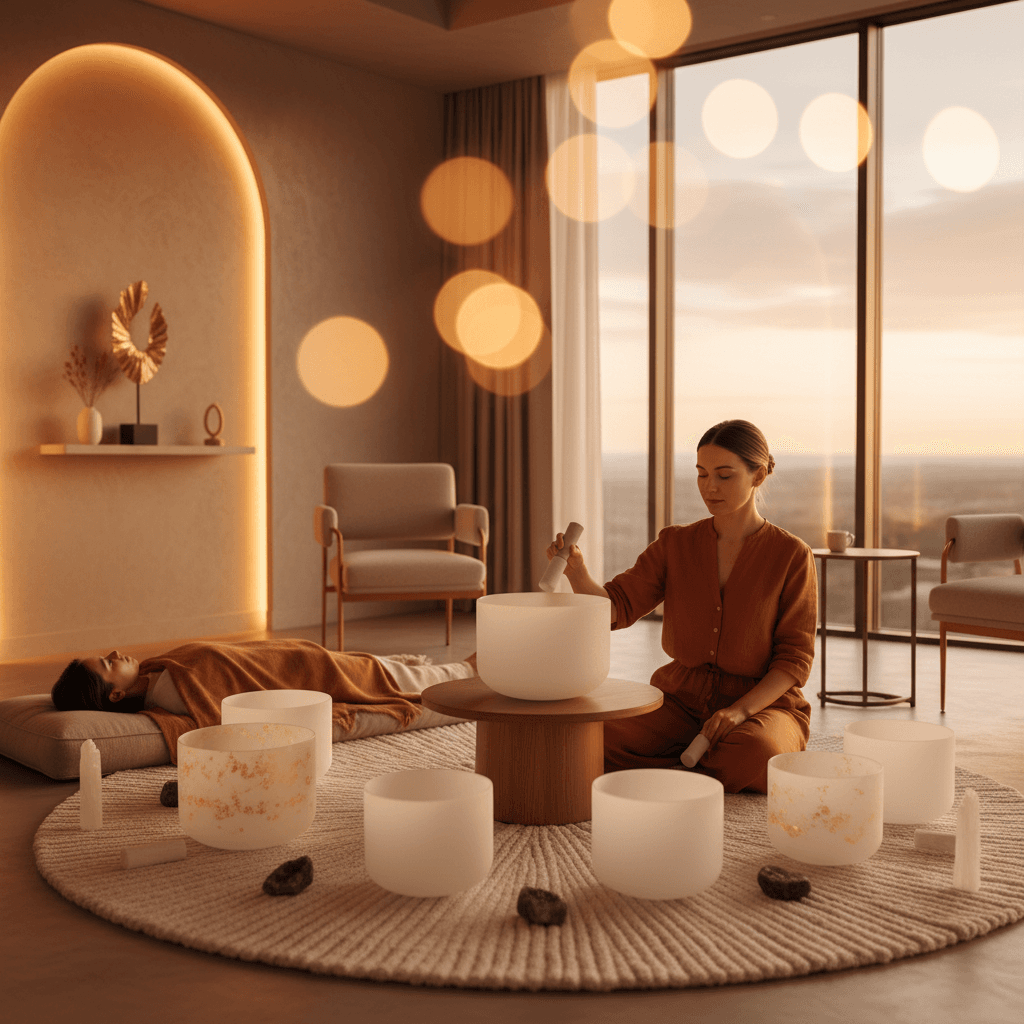
The Soul Art method employs a curated collection of instruments, including Himalayan singing bowls, crystal bowls, gongs, and chimes. Each instrument is chosen for its unique acoustic signature and its ability to generate specific pressure waves that propagate effectively through biological tissues. For instance, the pure, sustained tones of crystal bowls are known for their ability to create deep, pervasive vibrations.
During a session, the intentional placement of instruments and the expert manipulation of sound ensure that the vibrational energy is diffused harmoniously throughout the body. The goal is to facilitate a process where the body's cells and systems may gently re-attune to their optimal frequencies. This precise application of sound, guided by an understanding of wave mechanics, allows for a more profound and immersive experience.
Larissa Steinbach’s approach emphasizes not just the sound itself, but the way the sound moves through space and through the individual. This deep level of intentionality and scientific grounding makes Soul Art sessions unique, offering a complementary path to stress management, nervous system regulation, and overall holistic wellness that is deeply rooted in physical principles.
Integrating Sound Wisdom into Daily Life
Understanding the science of how sound propagates can empower you to engage more consciously with your acoustic environment and harness its potential for personal wellbeing. This knowledge demystifies the profound effects of sound and helps you appreciate its subtle yet powerful influence. Integrating sound wisdom into your daily life can be a simple yet transformative self-care practice.
Cultivating Personal Resonance
You can start by simply paying closer attention to the sounds around you. Notice how different sounds make you feel—do they invigorate, soothe, or create tension? This heightened awareness is the first step towards cultivating a more resonant personal environment. Consider creating a soundscape for your home or workspace that supports your desired emotional and mental states.
Engage in mindful listening, focusing on the textures and qualities of sounds rather than just their meaning. Simple practices like humming or chanting can also be powerful tools. These vocalizations create internal vibrations that propagate through your own body, potentially stimulating the vagus nerve and promoting a sense of calm. Exploring guided meditations that incorporate sound is another accessible way to experience these benefits.
Here are some actionable steps you can take today:
- Mindful Listening: Dedicate a few minutes each day to simply listen to your environment, noticing sounds without judgment.
- Personal Vocalization: Experiment with humming or gentle chanting for a few minutes to feel the vibrations within your body.
- Curate Your Sound Environment: Choose music or ambient sounds that promote relaxation and focus, avoiding those that cause agitation.
- Explore Nature's Acoustics: Spend time in natural settings, allowing the sounds of waves, birds, or wind to gently soothe your nervous system.
- Experience Professional Sound Wellness: Consider booking a session at a reputable studio like Soul Art to experience the profound effects of expertly guided sound propagation.
Bookings Coming Soon
Soul Art is still in preparation. Session details and booking will be published here after launch.
Coming Soon
In Summary: The Profound Journey of Sound
The journey of sound through different media is a profound testament to the intricate workings of the universe. We have explored how sound, a mechanical wave, relies on particle interactions, with its speed significantly influenced by a medium's density and elasticity. The phenomena of refraction, reflection, and attenuation constantly shape sound's path, dictating how its energy is transmitted or dispersed.
This scientific understanding offers invaluable insights into the efficacy of sound wellness practices. The human body, a complex blend of liquids, solids, and gases, acts as a sophisticated medium for these vibrations. Preliminary studies indicate that harmonizing sound may support cellular communication and facilitate a return to balanced physiological states.
At Soul Art, under the guidance of Larissa Steinbach, these scientific principles are thoughtfully applied to create environments conducive to deep relaxation and stress management. By experiencing the deliberate propagation of sound, individuals may discover a complementary path to holistic wellbeing. We invite you to explore this fascinating world and allow the science of sound to guide you towards inner harmony.
Wellness Disclaimer: This article is for educational and informational purposes only. It does not constitute medical advice, diagnosis, or treatment. Soul Art Dubai provides non-medical wellness experiences focused on relaxation, stress management, and general wellbeing. Sound wellness is a complementary practice and should not replace professional medical care.
Related Articles

40 Hz Sensory Stimulation and Alzheimer's Research
Unlocking Wellness: The Science of Sound Healing Research Design

Unlocking Wellness: Biomarkers for Effective Sound Therapy