Unlock Your Mind: Prefrontal Cortex Activation through Focused Sound Meditation
Key Insights
Explore how focused sound meditation activates the prefrontal cortex, enhancing focus, emotional regulation, and overall well-being. Discover Soul Art Dubai's unique approach with Larissa Steinbach.
Have you ever wondered if there's a profound, scientifically-backed method to sharpen your focus, regulate your emotions, and cultivate inner peace? In our fast-paced world, the demands on our cognitive abilities and emotional resilience are greater than ever before. Many of us seek pathways to not just cope, but to truly thrive.
This journey often leads us to explore the remarkable capabilities of our own brains. Specifically, we're talking about the prefrontal cortex, the executive control center of your brain, and how it can be powerfully influenced by focused sound meditation.
At Soul Art Dubai, under the expert guidance of our founder Larissa Steinbach, we delve into the neurobiological mechanisms that underscore these transformative practices. This article will unveil the science behind how precisely calibrated soundscapes and focused attention can unlock greater cognitive potential, fostering a deeper sense of well-being and mental clarity. Prepare to discover the profound connection between sound, your brain, and your capacity for calm.
The Science Explained: Unveiling Your Brain's Potential
The human brain is an astonishingly complex organ, capable of profound adaptation and change. At the heart of many of our most sophisticated cognitive functions lies the prefrontal cortex. Understanding its role and how focused sound meditation can influence it offers a compelling pathway to enhanced well-being.
The Prefrontal Cortex: Your Brain's Executive Command Center
The prefrontal cortex (PFC), located at the very front of your brain, is often considered the CEO of your cognitive operations. This critical region is responsible for a suite of "executive functions," including decision-making, planning, working memory, problem-solving, and impulse control. It also plays a pivotal role in emotional regulation, helping us to manage reactions to stress and navigate complex social situations.
When functioning optimally, the PFC supports clear thinking, emotional balance, and a sense of calm resilience. However, in states of chronic stress or mental overload, its efficiency can be compromised, leading to difficulties with focus, increased anxiety, and impaired decision-making.
Focused Attention Meditation and Unique Brain Activation
Emerging neuroscientific research consistently highlights the distinctive ways meditation impacts the brain, particularly the prefrontal cortex. Unlike other cognitive tasks that may induce temporary brain activity, focused meditation appears to foster unique, lasting changes.
A seminal study by Davanger et al. (2010), examining brain activation during relaxed focusing on a meditation sound, found remarkable results. Participants repeating a meditation sound showed "noticeably higher levels of activity" in BA47 (Brodmann area 47), a region within the inferior frontal gyrus of the prefrontal cortex, compared to performing concentrative cognitive tasks. Crucially, this meditation-specific brain activation "increased in strength over continuous meditation bouts rather than habituating over time." This suggests a cumulative, reinforcing effect rather than the brain simply getting used to the activity. These findings underscore that meditation with relaxed focus is associated with unique activation patterns in the prefrontal cortex, distinguishing it from other cognitive tasks.
Further research emphasizes the association between mindful awareness and localized brain activity within the prefrontal cortex. This intricate dance of neural activity helps us understand the neurobiological mechanisms underlying deep meditation.
Enhancing Neural Connectivity and Attentional Networks
Long-term engagement with focused meditation practices has been associated with significant enhancements in brain connectivity and the strengthening of key attentional networks. This is not merely about activating specific areas, but about improving the communication pathways between them.
One significant area of impact is on the Default Mode Network (DMN), which is active during mind-wandering and self-referential thought, and the Dorsal Attention Network (DAN), which engages when we focus attention on external tasks. Studies show that meditation training can enhance the brain's functional connectivity within the DAN, between the DMN and DAN, and even between the DMN and the visual cortex (Nature, 2021). This suggests that focused attention meditation, or FAM, can potentially improve the brain's ability to swiftly transition between states of mind-wandering and focused attention, and to maintain that attentive state once achieved.
Experienced meditators, for example, have exhibited increased activation in the anterior cingulate and medial prefrontal cortex—key prefrontal regions within the DMN—compared to controls (Nature, 2021). Similarly, long-term practitioners often demonstrate significantly more activation in a majority of attention regions of interest than novice meditators during their practice. These findings collectively suggest that meditation fosters a more integrated and flexible brain, capable of enhanced attentional control and self-awareness.
Specific Prefrontal Cortex Regions and Cognitive Benefits
The activation patterns seen during focused sound meditation extend to several other crucial areas within the prefrontal cortex, each contributing to a rich tapestry of cognitive and emotional benefits. For instance, studies on focused-attention meditation have shown enhanced bilateral dorsolateral prefrontal cortex (DLPFC) activation (Yamaya, PMC10026337). The DLPFC is vital for working memory, cognitive flexibility, and executive functions.
Additionally, mindfulness meditation has been associated with an increase in the functional connectivity of the right inferior frontal gyrus—a key hub for intentional inhibition and control—and the right anterior insula, which is important for sensory perception and emphasis (Sevinc et al., PMC10026337). These changes may support improved self-control and heightened present-moment awareness.
Even brief sessions of focused attention meditation can yield remarkable immediate benefits. A study utilizing functional near-infrared spectroscopy (fNIRS) demonstrated that just one 10-minute session of FAM could prevent behavioral state fatigue (ScienceDirect, 2024). This was achieved by modifying attention regulation through cognitive effort, indicated by decreased medial prefrontal cortex activity and increased functional connectivity between the left dorsomedial prefrontal cortex and right superior parietal lobule. This suggests that even short bursts of focused sound meditation can bolster our cognitive endurance and attention.
"The subtle vibrations and focused attention in sound meditation are not just soothing; they are powerful tools for sculpting the brain, enhancing its capacity for focus, clarity, and emotional equilibrium."
Furthermore, research indicates that music and sound interventions can directly influence brainwave activity. Studies have shown that types of relaxing music and even binaural beats (like those at 4 Hz, associated with theta waves) can increase alpha power in the prefrontal cortex, promoting relaxation, reducing stress and anxiety, and supporting improved sleep quality (PMC12599712). These effects are understood to work by influencing brainwave activity through auditory input systems, regulating emotional states. The brain’s response to sound can be a gentle yet effective way to steer it towards more beneficial patterns.
Finally, meditation is also revealing its capacity to induce changes in deep limbic brain regions, such as the amygdala and hippocampus, which are strongly associated with memory and emotional regulation (Mount Sinai, 2025). This holistic effect underscores that the benefits of focused sound meditation extend beyond the prefrontal cortex, influencing core emotional processing centers.
How It Works in Practice: The Embodied Experience of Sound
Connecting the intricate neuroscience to the tangible experience of sound meditation reveals its profound practicality. It’s one thing to read about brain activation; it’s another to feel it. At Soul Art, we bridge this gap, guiding our clients through an embodied journey that directly engages these neural mechanisms.
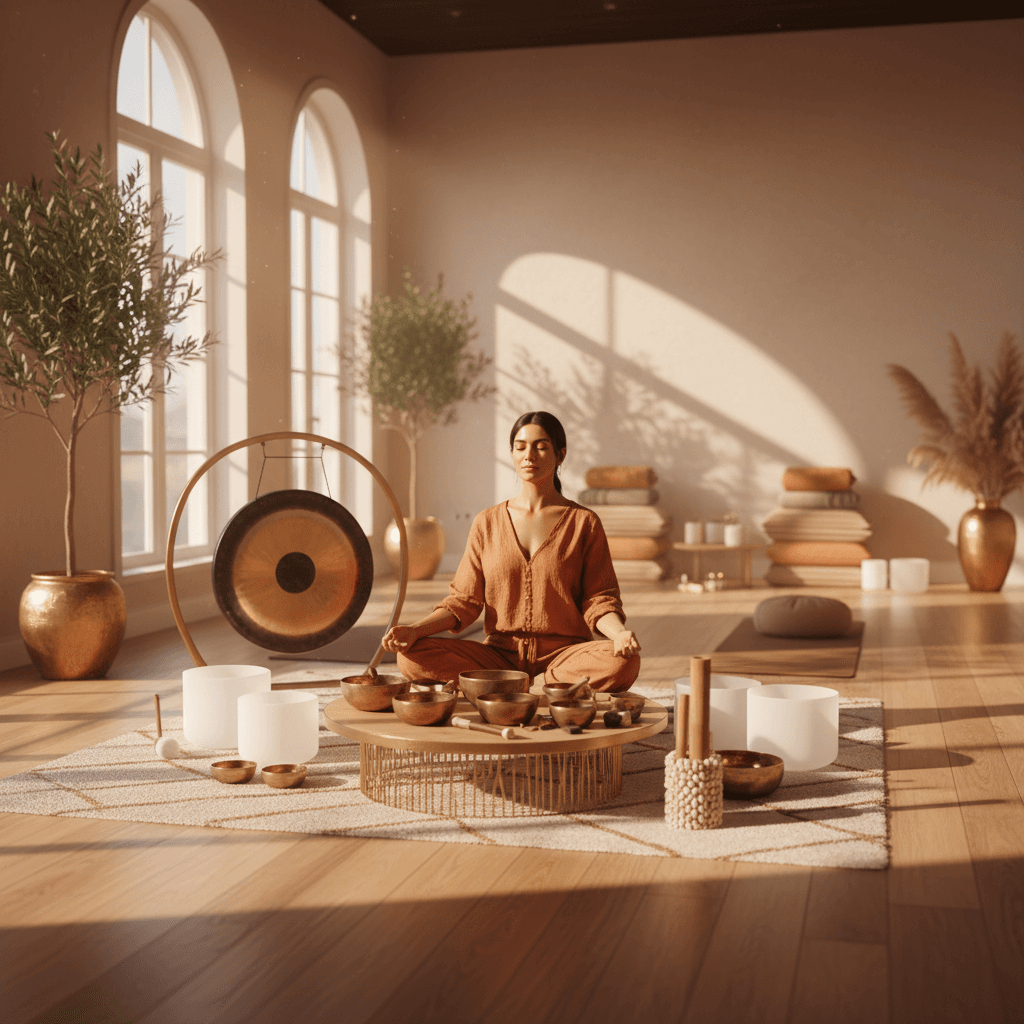
Imagine lying comfortably in a serene space, the gentle hum of crystal singing bowls beginning to fill the air. The sound is not merely heard; it’s felt, resonating through your body, a subtle vibration that invites your mind to settle. This is where the magic of focused sound meditation begins to unfold. As the sound deepens, perhaps with the rich resonance of gongs or the delicate chime of Koshi bells, your attention naturally converges on these auditory sensations. This focused attention acts as a gentle anchor, drawing your awareness away from the incessant chatter of daily thoughts and redirecting it to the present moment.
This act of focusing on the sound is key. It provides a non-demanding, yet engaging, object for your attention, which helps to quiet the Default Mode Network (DMN)—the part of your brain associated with mind-wandering, self-referential thought, and often, rumination. As the DMN quiets, the Dorsal Attention Network (DAN), closely linked to your prefrontal cortex, becomes more engaged. This is the neural mechanism behind improved focus and mental clarity experienced during and after a session.
Clients often report a noticeable shift in their mental state as the session progresses. Initially, the mind may resist, darting from thought to thought. But with the continuous, immersive sound, and gentle guidance to return attention to the auditory experience, a sense of deep relaxation begins to wash over them. The vibrations from instruments like gongs and singing bowls can also be perceived directly by the body, offering a physical grounding that complements the mental focus. This dual sensory input—auditory and kinesthetic—can be particularly effective in drawing the mind into a state of mindful awareness.
The sounds themselves, especially those with specific frequencies or rich harmonic overtones, may help to encourage the brain into states where alpha and theta brainwaves are more prevalent. These brainwave states are associated with deep relaxation, creativity, and a heightened sense of calm. By gently encouraging these brainwave patterns, focused sound meditation provides an optimal environment for the prefrontal cortex to activate in beneficial ways, supporting improved emotional regulation and cognitive function. Many people report leaving a session feeling not just relaxed, but also mentally refreshed, with a clearer perspective and a renewed ability to concentrate. It's a holistic experience that nurtures both mind and body.
The Soul Art Approach: Larissa Steinbach's Unique Vision
At Soul Art Dubai, the practice of focused sound meditation transcends a mere relaxation technique; it is a meticulously crafted experience designed to support profound well-being and cognitive enhancement. This unique approach is championed by our founder, Larissa Steinbach, whose expertise and intuitive understanding of sound's therapeutic potential define every session.
Larissa Steinbach's philosophy centers on creating bespoke soundscapes that are not just beautiful, but strategically attuned to guide the listener towards specific states of consciousness conducive to prefrontal cortex activation. She combines a deep scientific understanding of how sound impacts the brain with an artistic sensibility, creating an environment where healing and transformation can flourish. It's about precision, intention, and a profound respect for the individual's journey.
What makes the Soul Art method truly distinctive is Larissa’s curated selection and masterful playing of a diverse array of instruments. You might experience the deep, enveloping resonance of Nepalese gongs, which produce rich overtones that can help to entrain brainwaves towards meditative states. Or the pure, ethereal tones of crystal singing bowls, meticulously chosen for their vibrational qualities, which are believed to interact harmoniously with the body's energy centers. These are often complemented by the delicate, shimmering sounds of Koshi chimes or the precise frequencies of tuning forks, each selected for its unique contribution to the overall sound tapestry.
Larissa Steinbach's expertise extends beyond simply playing instruments; it involves intuitively reading the energy of the space and the needs of the participants, allowing her to adapt and personalize each session. She intentionally crafts sound sequences that gently encourage the mind to shift from the busy, analytical beta state to the more relaxed alpha and theta states, fostering an environment where the prefrontal cortex can engage in focused attention without effort or struggle. This practice is about creating a safe, nurturing space where the brain feels secure enough to let go of its habitual thought patterns and explore new neural pathways.
The Soul Art experience is more than just listening; it’s about tuning in—tuning into the self, tuning into the present moment, and tuning into the subtle frequencies that support our innate capacity for balance and clarity. It is a sophisticated, yet accessible, path to cultivating a more resilient mind and a more peaceful existence, all within the luxurious and tranquil setting of Soul Art Dubai.
Your Next Steps: Integrating Sound for Enhanced Well-being
The insights into prefrontal cortex activation through focused sound meditation highlight a powerful, yet accessible, self-care practice. Incorporating sound into your daily routine or exploring guided sessions can be a transformative step towards greater focus, emotional balance, and overall well-being. You don't need to be an expert to start; the key is consistent, mindful engagement.
Here are some practical steps you can take today to begin integrating the power of sound into your life:
- Start Small with Mindful Listening: Begin with just 5-10 minutes each day. Choose a calming piece of music, nature sounds, or even a simple resonant tone. Your goal is not to analyze the sound, but to simply listen without judgment, allowing your attention to rest gently on the auditory experience. This helps to train your prefrontal cortex in focused attention.
- Create a Dedicated Sound Space: Designate a quiet corner in your home where you can engage with sound without interruption. This sacred space can be enhanced with comfortable seating, soft lighting, and perhaps a diffuser with a calming essential oil. A consistent environment can reinforce your meditation practice.
- Explore Guided Sound Meditations: Many apps and online platforms offer guided sound meditations. These can be particularly helpful for beginners, as the guide's voice helps anchor your attention and leads you through the experience. Look for sessions that specifically mention focus, relaxation, or prefrontal cortex activation.
- Integrate Sound into Daily Rituals: Pair sound with existing routines. Listen to calming music while preparing your morning coffee, during a commute, or as part of your bedtime ritual. Consistency helps build new neural habits and strengthens the beneficial activation of your prefrontal cortex.
- Observe and Reflect: After each sound session, take a moment to notice any shifts in your mental state, emotional response, or clarity of thought. Keeping a short journal can help you track progress and identify the types of sounds or practices that resonate most deeply with you.
Embracing sound as a tool for wellness is a journey of self-discovery. It’s a gentle yet potent way to support your brain's capacity for optimal function. For those seeking a deeper, expertly guided experience, Soul Art Dubai offers a unique sanctuary.
In Summary: A Harmonic Path to Cognitive Clarity
The journey through the intricate world of the prefrontal cortex and focused sound meditation reveals a profound truth: our brains are wonderfully responsive to intentional, harmonious input. We've explored how practices like Focused Attention Meditation, especially when guided by sound, can uniquely activate crucial prefrontal regions like BA47 and the inferior frontal gyrus, with this activation deepening over time. This process enhances neural connectivity, strengthens attentional networks, and supports vital functions like emotional regulation, decision-making, and freedom from mental fatigue.
The scientific evidence points to sound meditation as a powerful, non-invasive method for nurturing cognitive function and fostering mental resilience. By gently guiding the brain into states of focused awareness, we can cultivate greater clarity, reduce stress, and achieve a deeper sense of inner peace. Larissa Steinbach at Soul Art Dubai has meticulously crafted an approach that leverages these neuroscientific principles, offering a unique and luxurious path to holistic well-being through expertly designed sound experiences.
Bookings Coming Soon
Soul Art is still in preparation. Session details and booking will be published here after launch.
Coming Soon
Wellness Disclaimer: This article is for educational and informational purposes only. It does not constitute medical advice, diagnosis, or treatment. Soul Art Dubai provides non-medical wellness experiences focused on relaxation, stress management, and general wellbeing. Sound wellness is a complementary practice and should not replace professional medical care.
Related Articles

Cluster Headaches: Unveiling Pain and the Promise of Frequencies in Wellness

Epilepsy & Sound: Safety, Serenity, and Emerging Wellness Paths
Mastering Focus: Analytical Listening & Brain Engagement at Soul Art