Painters and Sound: The Science of Color and Frequency

Key Insights
Explore the profound link between sound and color. Soul Art founder Larissa Steinbach delves into the science of chromesthesia and how specific frequencies can influence our perception and wellbeing.
Have you ever listened to a piece of music and felt it had a distinct color? Perhaps a deep, resonant cello note felt like a rich burgundy, while a trilling flute sounded like a flash of bright silver. For the painter Wassily Kandinsky, a pioneer of abstract art, this was not just a poetic metaphor; it was a perceived reality. He famously stated, “the sound of colors is so definite that it would be hard to find anyone who would express bright yellow with bass notes or dark lake with treble.”
This profound intersection of our senses is not limited to artistic genius. It points to a fundamental way our brains are wired, a constant, subconscious dialogue between what we see and what we hear. In this journal, we will journey into the science behind this fascinating phenomenon, exploring the concepts of crossmodal correspondence and synesthesia. You will learn how the physical properties of sound—its frequency, pitch, and volume—are intrinsically linked to the visual spectrum. Most importantly, we will uncover how understanding this connection can serve as a powerful tool for relaxation, creative flow, and holistic wellbeing, forming the very foundation of the work we do here at Soul Art.
The Science Explained
The relationship between sound and color has captivated philosophers, scientists, and artists for centuries, from the ancient Greeks who correlated the seven notes of a musical scale with the seven known planets, to Isaac Newton’s theories on their shared frequencies. Today, neuroscience is providing a clearer picture of this intricate sensory dance.
### Crossmodal Correspondence: The Brain's Symphony
Our brains do not process sensory information in isolated silos. Instead, they engage in crossmodal correspondence, a remarkable ability to integrate information from different senses to create a cohesive understanding of the world. This is why we might instinctively associate a high-pitched sound with a small object or a deep, booming sound with something large and imposing. It's a fundamental aspect of perception.
Research has demonstrated consistent patterns in these associations. Studies show that most people, regardless of cultural background, link certain sonic qualities to specific visual ones. These correspondences often follow logical patterns related to intensity and frequency:
- Pitch: High-pitched sounds are consistently associated with brighter, lighter colors, while low-pitched sounds are linked to darker colors. This aligns perfectly with Kandinsky's observation.
- Volume & Dynamics: Louder sounds are perceived as brighter and more saturated colors, whereas softer sounds are seen as more muted or pastel.
- Tempo: Faster music is often linked to warmer, more energetic colors like reds and oranges, while slower tempos evoke cooler, calmer colors like blues and greens.
### Synesthesia: Seeing Sound, Hearing Color
For a small percentage of the population, these crossmodal links are not just implicit associations but vivid, involuntary sensory experiences. This neurological trait is called synesthesia, which translates from Greek as "perceiving together." The most famous form in this context is chromesthesia, or sound-to-color synesthesia, where individuals literally see colors when they hear sounds.
For the synesthete, music is not just an auditory experience; it is a full-blown visual spectacle, a private light show orchestrated by the brain. While this is a rare condition, it serves as a powerful illustration of the deep, pre-existing neural pathways that connect sound and color in all of us.
Researchers believe synesthesia may be caused by an unusual degree of cross-activation between adjacent sensory areas of the brain. While most of us have these pathways, in synesthetes, they are far more active. Studying this phenomenon provides invaluable insights into how all brains process and integrate sensory input, revealing a shared, underlying "grammar" of the senses.
### The Physics of Perception: Frequency and Vibration
The connection goes beyond psychological association; it is rooted in the physics of waves. Both sound and light travel in waves, defined by their frequency (how fast the wave oscillates) and amplitude (the intensity or height of the wave). Groundbreaking studies in haptics—the science of touch and vibration—have shown direct correlations between vibrotactile frequencies and color choice.
- Low Frequencies (e.g., less than 40 Hz): When participants felt low-frequency vibrations, they consistently chose colors in the violet and red hues. Interestingly, as the amplitude (intensity) of these vibrations increased, the color choice shifted from violet towards a more dominant red.
- High Frequencies (e.g., 60 Hz and above): Conversely, higher-frequency vibrations predominantly evoked colors in the green range.
This suggests that our sensory systems may be tuned to associate the slow, deep energy of low frequencies with the longer wavelengths of red light, and the faster, lighter energy of high frequencies with the shorter wavelengths of green and blue light.
How It Works in Practice
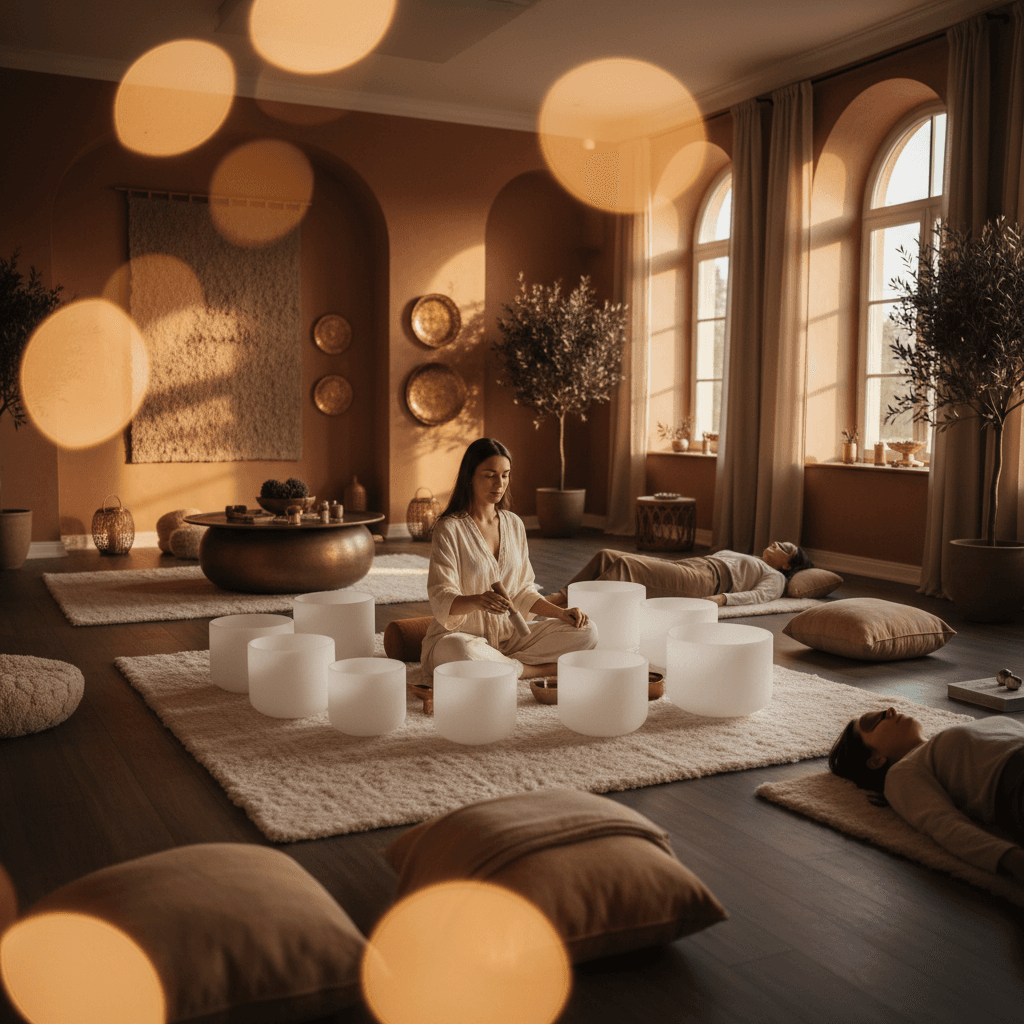
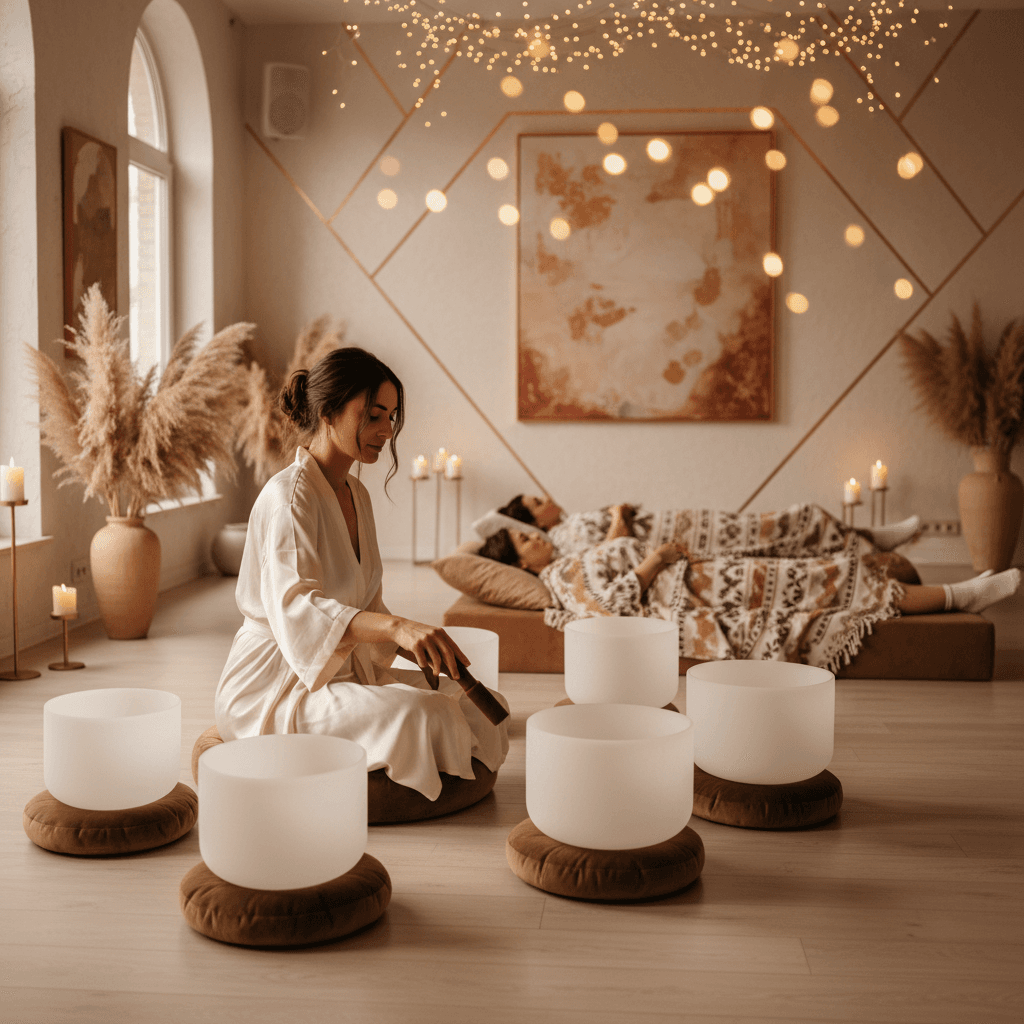
Understanding the science is one thing, but feeling its effects is another. At its core, sound wellness is an applied science, transforming these abstract principles into a tangible experience that can be felt throughout the body, not just understood by the mind. When you lie down for a sound bath, you are stepping into a curated environment where color is painted with frequency.
Imagine the deep, resonant hum of a large gong. Its low-frequency waves are not just heard by your ears; they are felt as a physical vibration that permeates your body. Based on the scientific correspondences, this experience is aligned with the colors deep red, violet, and rich earth tones. These frequencies are often associated with a sense of grounding, stability, and connection to the physical body. Many people report feeling a calming, rooting sensation, as if being gently held by the earth.
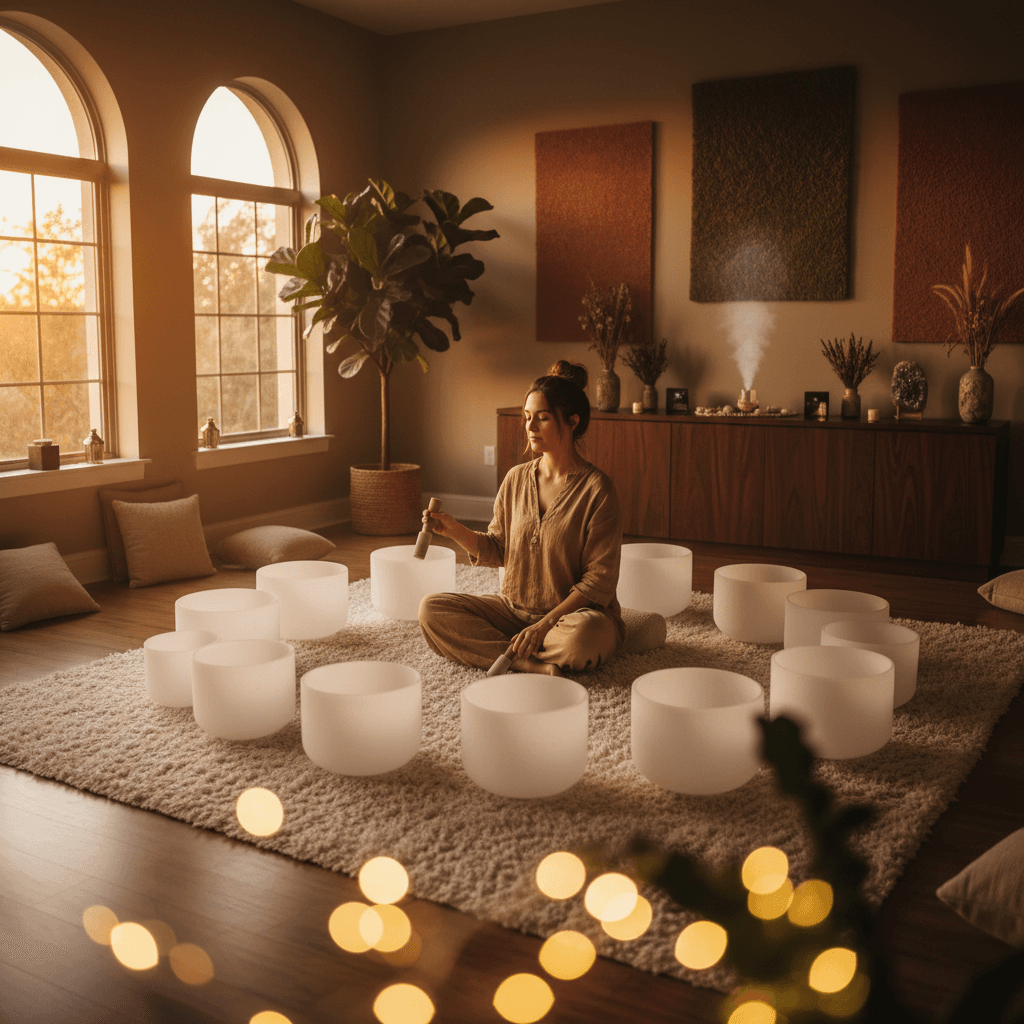
Now, contrast that with the crystalline, high-pitched ring of a quartz crystal singing bowl. Its pure, high-frequency sine wave is light, ethereal, and expansive. This sound is often perceived as bright white, silver, or a luminous green. The physical sensation is less of a rumble and more of a subtle tingle or a feeling of spaciousness opening up in the chest and head. This experience is often associated with clarity, lightness of being, and an elevated state of awareness. A session becomes a journey through a sonic color field, moving from the grounding bass notes of dark colors to the uplifting treble of light.
The Soul Art Approach
Here at Soul Art, this knowledge is not just an interesting theory; it is the guiding principle behind every session. As the founder, Larissa Steinbach meticulously curates soundscapes that are designed to facilitate specific states of being, using a deep understanding of the interplay between frequency, color, and human physiology. We view our collection of instruments as a painter's palette.
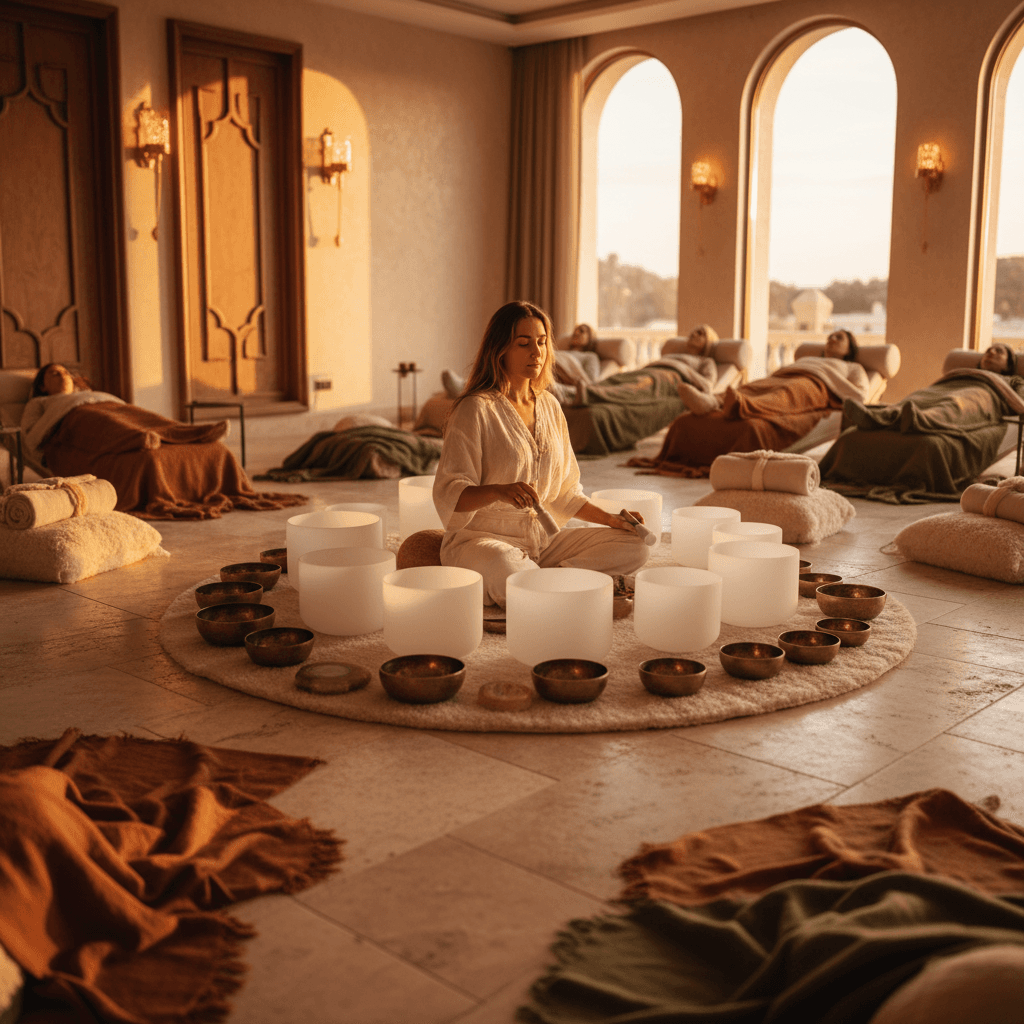
Our method is unique because it is both intuitive and scientifically informed. We don't just play instruments; we compose experiences. A session might begin with the deep, foundational tones of large Himalayan bowls to encourage a state of physical relaxation and grounding—our "dark lake" colors. From there, we might introduce the complex, layered overtones of a symphonic gong, which can feel like a wash of vibrant, shifting hues, helping to release energetic stagnation.
The session may then transition to the higher frequencies of tuning forks and Koshi chimes, which can feel like sparks of gold and silver, intended to elevate the spirit and clear the mind. This intentional layering of sound creates a full-spectrum experience. The Soul Art approach is a form of sensory alchemy, using the precise application of frequency to support the body's innate capacity for balance and harmony, painting a masterpiece of wellbeing within you.
Your Next Steps
You don't need to be a synesthete or a neuroscientist to begin exploring this powerful connection in your own life. You can start tuning into your personal sensory world today with a few simple, mindful practices. This exploration can be a beautiful form of self-care, enhancing your awareness and adding a new dimension to your daily experiences.
Here are a few ways to begin:
- Mindful Music & Color Journaling: Put on a piece of instrumental music—classical, ambient, or electronic. As you listen, close your eyes and simply notice what colors, shapes, or textures come to mind. Don't judge or analyze; just observe. Afterwards, jot down or even sketch what you "saw."
- Color Breathing: Choose a color that represents a state you wish to cultivate (e.g., calm blue, energetic orange). Sit quietly, and as you breathe in, visualize inhaling this color, imagining it filling your entire body. As you exhale, release any colors associated with stress or tension.
- Sensory Environment Scan: Take a moment during your day to notice the "color" of the sounds around you. Is the low hum of the air conditioner a deep grey? Is a bird's song a splash of yellow? This practice sharpens your crossmodal awareness.
- Explore with Intention: When choosing music for different activities, consider its potential color. You might choose "green" or "blue" ambient sounds for focused work and "red" or "orange" rhythmic music for a workout.
These simple practices can deepen your connection to your senses. To explore this relationship in a professionally guided and immersive environment, consider experiencing a sound wellness session designed to harmonize your inner world.
In Summary
The bond between color and sound is a testament to the beautifully integrated nature of human perception. It is a language written in the physics of waves and interpreted by the intricate symphony of our brain. From the artistic visions of painters like Kandinsky to the precise findings of modern neuroscience, we see that what we hear profoundly influences what we feel and, in a sense, what we "see."
This connection is more than a curiosity; it is a pathway to deeper wellbeing. By consciously working with specific frequencies and their associated color energies, we can create experiences that may support profound relaxation, reduce stress, and unlock creative potential. At Soul Art, we invite you to move beyond simply hearing sound and begin to feel it in full color, restoring harmony to your mind, body, and spirit.
Bookings Coming Soon
Soul Art is still in preparation. Session details and booking will be published here after launch.
Coming Soon