Harmonic Frequencies: Balancing GABA & Glutamate for Brain Wellness
Key Insights
Explore how sound wellness and harmonic frequencies may support the delicate GABA and Glutamate balance for optimal brain function and tranquility with Soul Art Dubai.
Have you ever considered that the delicate rhythm of your inner world, the very symphony of your thoughts and feelings, is conducted by a meticulous dance of neurochemicals? Our brains are intricate powerhouses, constantly processing information, emotions, and sensations. This complex process relies heavily on a precise equilibrium between excitatory and inhibitory signals.
At the heart of this neural harmony lie two crucial neurotransmitters: GABA (gamma-aminobutyric acid) and Glutamate. Their delicate balance is fundamental to everything from your mood and focus to your ability to relax and sleep deeply. When this balance is disrupted, it can impact overall well-being, leading to feelings of unease or overstimulation.
This article delves into the fascinating neuroscience behind GABA and Glutamate, exploring their vital roles in brain function. We will then uncover how the intentional application of harmonic frequencies, as practiced at Soul Art by Larissa Steinbach, may offer a unique and complementary approach to supporting this essential neurochemical equilibrium, guiding you towards profound states of calm and clarity.
The Science Explained: The Brain's Neurochemical Symphony
Our central nervous system is a bustling network where billions of neurons communicate through electrical and chemical signals. This communication is orchestrating every aspect of our existence. To function optimally, this network requires a finely tuned excitation/inhibition (E/I) balance. Without this balance, neural circuits can become either overactive or underactive, leading to various challenges in brain function.
Maintaining this equilibrium is paramount for processes like learning, memory, mood regulation, and even sensory perception. Research using advanced techniques like Magnetic Resonance Spectroscopy (MRS) consistently highlights the critical role of GABA and Glutamate in this delicate dance, linking imbalances to various neurological and psychological conditions.
Glutamate: The Brain's Primary Excitatory Conductor
Glutamate is the most abundant amino acid in the vertebrate nervous system and serves as the primary excitatory neurotransmitter. Its role is to stimulate neural activity, promoting the "firing" of neurons and increasing neuronal excitability. This excitatory function is crucial for fundamental brain processes such as learning, memory formation, and cognitive flexibility.
Glutamate activates a range of receptors on postsynaptic neurons, leading to depolarization and increased neuronal firing. Beyond its role as a neurotransmitter, glutamate is also a metabolic powerhouse, participating in osmotic balance and ammonia homeostasis, and serving as a precursor for other essential brain compounds, including GABA itself. However, excessive glutamate can lead to overstimulation and excitotoxicity, underscoring the need for precise regulation.
GABA: The Brain's Calming Inhibitory Influence
In stark contrast to glutamate, GABA (gamma-aminobutyric acid) is the main inhibitory neurotransmitter in the central nervous system. Its primary function is to dampen excessive neuronal activity, effectively putting the "brakes" on overstimulated neural circuits. By inducing hyperpolarization of postsynaptic neurons, GABA reduces the likelihood of neuronal firing, thereby maintaining stability within neural networks.
This inhibitory action is vital for promoting relaxation, reducing anxiety, and fostering restful sleep. Dysfunction in GABAergic systems has been associated with a range of psychiatric conditions, including depression, anxiety disorders, and schizophrenia, highlighting its critical role in mental well-being. The precise modulation of GABAergic activity is therefore a key focus in neuroscience research.
The Critical Excitation/Inhibition (E/I) Balance
The constant interplay between glutamate's excitatory drive and GABA's inhibitory control defines the brain's E/I balance. This equilibrium is not static but dynamically regulated, adapting to changing demands and stimuli. Stable global neuronal activity, essential for complex brain processes, is achieved through this coordinated balance.
Research reveals region-specific dynamics in this relationship. For instance, studies show an extreme positive correlation between GABA+ and Glutamate (Glu) levels in the prefrontal cortex, a region vital for executive functions. Similarly, in the occipital cortex, involved in visual processing, strong evidence indicates a positive relationship between GABA+ and both Glx (Glutamate + Glutamine) and Glu. This demonstrates that while the brain strives for balance, the specific metabolic coupling of these neurotransmitters varies depending on the brain region and its specialized functions.
"The brain's ability to seamlessly switch between states of alert focus and deep relaxation is a testament to the exquisite orchestration of its neurochemical symphony, where GABA and Glutamate play the leading roles in maintaining harmonious balance."
Disruptions to this E/I balance have been implicated in the pathophysiology of numerous conditions. For example, lower levels of both glutamate and GABA have been observed in the auditory cortex of individuals experiencing tinnitus, suggesting a potential role of imbalance in sensory processing disorders. Similarly, an E/I imbalance is considered a contributing factor in neurodevelopmental, neurodegenerative, and neurological diseases. Thus, supporting this fundamental balance is crucial for optimal brain health and overall nervous system regulation.
Frequency-Dependent Modulation: A Bridge to Sound Wellness
One of the most intriguing aspects of neurotransmitter balance, particularly relevant to sound wellness, is the concept of frequency-dependent modulation. Studies investigating glutamate/GABA co-transmission have shown that these neurotransmitters, while sometimes co-released from the same synaptic terminals, can exhibit independent release properties and differential short-term plasticity.
Crucially, this co-transmission can modulate neuronal activity in a frequency-dependent manner. This finding suggests that specific frequencies or patterns of neuronal stimulation—or potentially, external harmonic frequencies—could influence the delicate balance and release characteristics of these vital neurotransmitters. It provides a neurobiological framework for understanding how external stimuli, like sound, could impact the internal neurochemical environment.
How It Works in Practice: Harmonic Frequencies and Inner Calm
The scientific understanding of GABA and Glutamate balance provides a compelling foundation for exploring the potential benefits of sound wellness practices. When we immerse ourselves in carefully crafted harmonic frequencies, we engage our auditory system and, profoundly, our entire nervous system. This engagement is far more than just "listening"; it's a full-body experience of vibration and resonance.
The brain, being an electrical and chemical organ, is highly responsive to external rhythms and frequencies. This phenomenon, known as entrainment, describes the brain's natural tendency to synchronize its brainwave activity with external, repetitive rhythmic stimuli. When exposed to specific harmonic frequencies, the brain may gently shift into calmer, more meditative states, such as alpha and theta brainwave patterns, which are associated with deep relaxation and reduced mental chatter.
Preliminary studies on music therapy have shown direct effects on amino acid neurotransmitter levels, including glutamate and GABA. For instance, specific types of "Chinese Traditional Five-Elements Music Therapy" have been observed to produce different effects on these neurotransmitters in the striatum of rats. Some melodic patterns were associated with an increase in GABA, while others influenced glutamate levels or maintained a stable balance. This pioneering research provides anecdotal evidence suggesting that distinct soundscapes may have the potential to subtly influence the brain's neurochemical landscape, supporting the E/I balance.
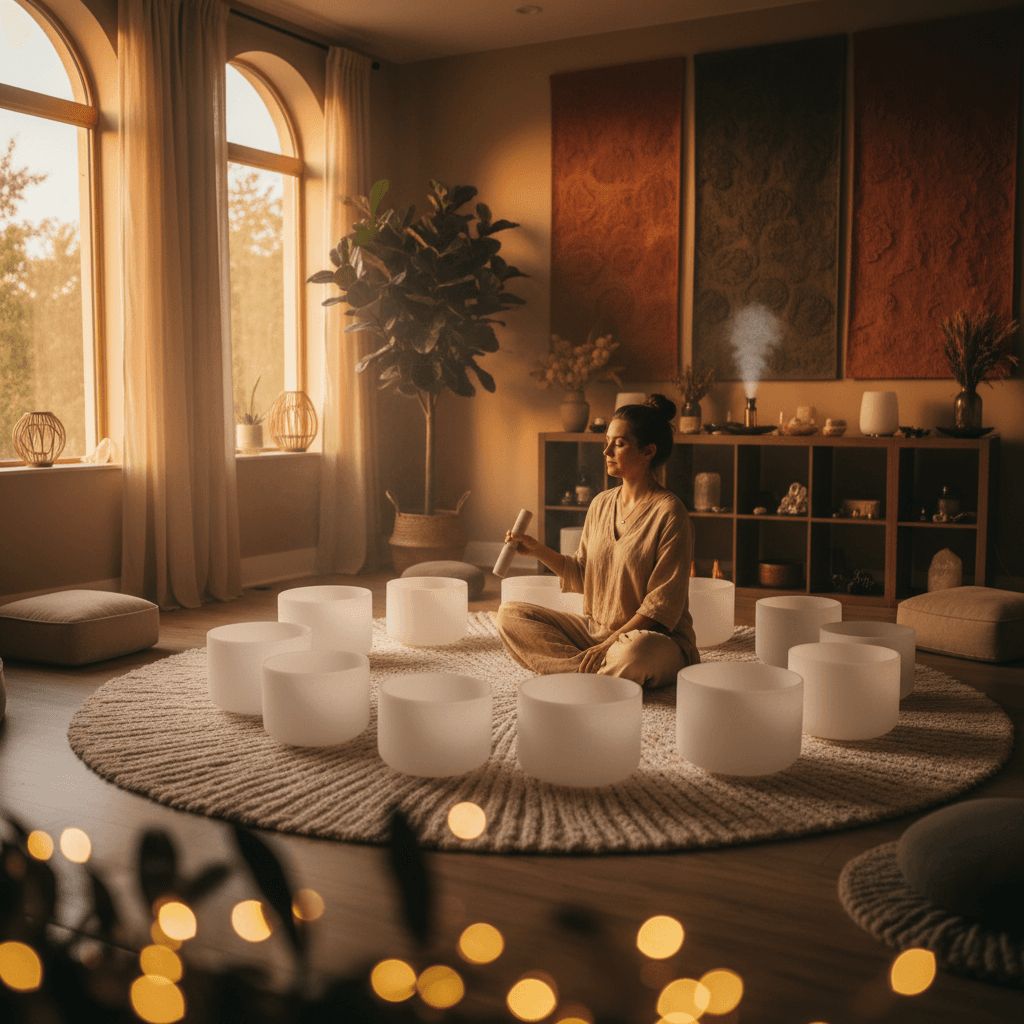
As clients experience the carefully curated soundscapes, the rich tapestry of overtones and undertones creates a deeply immersive environment. This immersive experience is not about conscious effort but about allowing the body and mind to simply receive the vibrations. Many people report feeling a profound sense of peace, a slowing of racing thoughts, and a release of physical tension. These subjective experiences align with the physiological states associated with healthy GABAergic activity and a regulated nervous system. The vibrations permeate the body, encouraging a sense of cellular resonance that many believe aids in harmonizing internal rhythms. This is a complementary approach designed to foster a state where the brain can naturally gravitate towards a more balanced E/I state.
The Soul Art Approach: Larissa Steinbach's Curated Harmony
At Soul Art, Dubai's premier sound wellness studio, Larissa Steinbach has meticulously developed a unique approach to harnessing the power of harmonic frequencies. Her method is rooted in the understanding that sound is not merely an auditory phenomenon but a vibrational force that can profoundly interact with the body's subtle energy systems and, by extension, its neurochemistry. The Soul Art experience is designed to be a sophisticated, holistic journey towards inner balance and deep relaxation.
Larissa's philosophy emphasizes the intentional selection and masterful playing of a diverse array of sacred sound instruments. These are not randomly chosen but are specific tools revered for their unique vibrational signatures and their capacity to produce rich, resonant overtones. These instruments include:
- Ancient Gongs: Known for their deep, enveloping tones that create a profound sense of immersion and can lead to altered states of consciousness. Their complex sound frequencies are believed by many to encourage brainwave entrainment towards meditative states.
- Himalayan Singing Bowls: Crafted from various metals, these bowls produce pure, sustained tones that resonate through the body, promoting relaxation and energetic alignment. Their vibrations are often felt at a cellular level, aiding in tension release.
- Crystal Singing Bowls: Made from quartz crystal, these bowls emit clear, ethereal tones with a highly focused vibration, believed by many to resonate with specific energy centers in the body.
- Tuning Forks: Precision-calibrated tools that produce specific frequencies, often used to target particular areas or to create specific energetic shifts within the body, promoting a sense of coherence.
What makes the Soul Art method truly unique is Larissa Steinbach's expertise in curating these instruments into bespoke sound journeys. She intuitively blends these harmonic frequencies, creating layered soundscapes that gently guide the nervous system towards a state of equilibrium. The sessions are carefully structured to introduce frequencies that may support the body's natural capacity to regulate its neurochemistry, encouraging the brain to move towards states where the E/I balance is optimized. This is a self-care practice designed to support the natural healing processes of the body, allowing individuals to release stress, calm the mind, and experience a revitalized sense of well-being.
Your Next Steps: Cultivating Neurochemical Harmony
While the complex interplay of GABA and Glutamate is largely an unconscious process, there are many accessible steps you can take to foster an environment conducive to their healthy balance. Integrating complementary wellness practices into your daily routine can support your brain's natural regulatory mechanisms.
Consider these actionable steps to cultivate greater neurochemical harmony and enhance your overall well-being:
- Prioritize Restful Sleep: Consistent, high-quality sleep is fundamental for neurotransmitter regulation. Aim for 7-9 hours of uninterrupted sleep each night to allow your brain to reset and rebalance.
- Embrace Mindfulness and Meditation: Regular practice of mindfulness, even for just a few minutes daily, has been associated with reduced stress and may support brain health. These practices can help regulate the nervous system, which in turn may positively influence neurotransmitter balance.
- Nourish Your Body: A diet rich in whole foods, lean proteins, and healthy fats provides the essential building blocks for neurotransmitter synthesis. Specific nutrients, like magnesium and B vitamins, are vital cofactors in these biochemical pathways.
- Engage in Gentle Movement: Physical activity, particularly practices like yoga or walking in nature, can help manage stress and support overall brain function. Movement is a powerful tool for nervous system regulation.
- Explore Sound Wellness: As a profound complementary approach, consider integrating harmonic frequency sessions into your self-care routine. The immersive experience may offer a unique pathway to deep relaxation and support for your brain's natural rhythm.
Ready to explore the profound potential of harmonic frequencies for your well-being? We invite you to experience the transformative power of a Soul Art session.
Bookings Coming Soon
Soul Art is still in preparation. Session details and booking will be published here after launch.
Coming Soon
In Summary
The intricate dance between GABA, the brain's primary inhibitory neurotransmitter, and Glutamate, its main excitatory counterpart, is fundamental to optimal brain function and overall well-being. Maintaining this crucial excitation/inhibition (E/I) balance is essential for everything from mental clarity to emotional resilience. Disruptions to this balance have been associated with various challenges to mental health.
Emerging research suggests that harmonic frequencies may offer a unique and complementary pathway to support this delicate neurochemical equilibrium. Through the principle of entrainment and the direct influence observed in preliminary music therapy studies, sound can gently guide the brain towards more balanced states. Larissa Steinbach's expertly curated sound wellness experiences at Soul Art leverage the profound power of gongs, singing bowls, and other sacred instruments to create an immersive environment. This environment is designed to promote deep relaxation and encourage the natural restoration of your nervous system's harmony. Embrace this holistic wellness practice to rediscover your inner calm and clarity.
Wellness Disclaimer: This article is for educational and informational purposes only. It does not constitute medical advice, diagnosis, or treatment. Soul Art Dubai provides non-medical wellness experiences focused on relaxation, stress management, and general wellbeing. Sound wellness is a complementary practice and should not replace professional medical care.
Related Articles
Cluster Headaches: Unveiling Pain and the Promise of Frequencies in Wellness
Epilepsy & Sound: Safety, Serenity, and Emerging Wellness Paths
Mastering Focus: Analytical Listening & Brain Engagement at Soul Art