The Future of Sound Healing: What Science Needs to Study

Key Insights
Explore the growing scientific evidence for sound wellness and discover what future research must address. Learn how Soul Art bridges ancient wisdom with modern science.
Have you ever noticed how a particular piece of music can instantly shift your mood, or how the sound of ocean waves can lull you into a state of deep calm? This intuitive human connection to sound is now at the forefront of a wellness revolution, an industry that has grown to over $4.2 trillion. Unlike fleeting trends built on anecdote, sound wellness is increasingly attracting the attention of researchers at major institutions like UCLA and Stanford University.
These pioneering studies are beginning to validate what ancient traditions have known for millennia: that specific frequencies and vibrations can have a profound impact on our physical and psychological states. But as we stand at this exciting intersection of ancient wisdom and modern neuroscience, a critical question emerges. What does the evidence really say, and more importantly, what are the gaps in our understanding that future research must address? This article explores the current scientific landscape, the promising future of sound-based evidence, and the areas that demand deeper, more rigorous investigation.
The Science Explained: From Brainwaves to Cellular Response
The journey to scientifically validating sound wellness is complex but incredibly promising. Researchers are moving beyond simple observation and using advanced technology to measure the tangible effects of sound on the human body, revealing a fascinating story of how vibration can influence us from our brain activity down to our very cells.
The Current Landscape: A Promising Foundation
The conversation around sound wellness is no longer confined to spiritual circles; it’s happening in research labs and being published in peer-reviewed journals. A growing body of evidence, including studies in the Journal of Evidence-Based Integrative Medicine and Nature Biotechnology, documents the potential of sound as a complementary tool for managing various conditions.
Breakthrough studies using electroencephalography (EEG) technology have shown that the frequencies produced by instruments like Himalayan singing bowls and gongs can guide the brain from agitated, high-frequency beta waves (associated with active thought and stress) to calmer alpha, theta, and even delta waves (associated with relaxation, meditation, and deep sleep). This measurable shift in brainwave entrainment is a cornerstone of modern sound wellness research.
Key findings from preliminary studies suggest associations between sound practices and:
- Reduced feelings of tension, anger, and fatigue.
- Improved mood and a decrease in reported anxiety and depression symptoms.
- Support for pain management, with some studies on fibromyalgia showing that low-frequency sound stimulation helped participants reduce their reliance on pain medication.
Mechanisms of Action: How Does Sound Influence Us?
The "how" behind sound's effects is a multi-layered process that science is just beginning to fully map out. The primary mechanisms currently being explored include:
-
Psychoacoustics: This field studies the psychological and physiological effects of sound. It explores how our brain perceives and interprets auditory information, triggering emotional and hormonal responses. This is why a major key can feel uplifting while a minor key can evoke melancholy.
-
Binaural Beats: A specific psychoacoustic phenomenon occurs when you listen to two slightly different frequencies in each ear. For example, if your left ear hears 200 Hz and your right hears 210 Hz, your brain perceives a third, phantom beat at the difference—10 Hz. This 10 Hz frequency falls within the alpha brainwave range, and the theory is that listening to these beats can encourage your brain to enter that relaxed, meditative alpha state.
-
Vibrational & Cellular Impact: Sound is not just something we hear; it is physical vibration. Research has begun to explore how these vibrations affect us at a cellular level. Studies have indicated that low-frequency vibration can enhance neuronal cell differentiation and proliferation, hinting at potential applications in regenerative medicine that are still in their infancy.
As we delve deeper into the science, we find that sound is a language the body understands at a fundamental level. It’s a dialogue that bypasses the conscious mind to communicate directly with our nervous system.
The Gaps in Our Knowledge: A Call for Rigorous Research
Despite the exciting progress, it is crucial to approach the existing evidence with a discerning and honest perspective. The field is still young, and many online claims outpace the current scientific consensus. The future of sound wellness depends on addressing these gaps with high-quality research.
A 2023 systematic review in PLoS One found contradictory evidence for binaural beats, with some studies showing effects and others none, leading researchers to conclude that more standardized, robust studies are needed. Similarly, a review on singing bowls noted that while results for anxiety and sleep were promising, many of the studies were small, highly variable, and carried a high risk of bias.
Here are the key areas that need better study:
- Larger, Controlled Trials: Many current studies use small, convenience samples with no control group. Future research needs to implement Randomized Control Trials (RCTs) to clearly distinguish the effects of sound from placebo or simple relaxation.
- Standardized Protocols: The type of instrument, duration of session, and environmental factors vary wildly between studies. Establishing standardized protocols would allow for more comparable and reliable data.
- Objective Physiological Measures: While self-reported improvements in mood are valuable, future studies should incorporate more objective biomarkers of stress, such as cortisol levels, heart rate variability (HRV), and blood pressure.
- Specificity of Frequencies: Sweeping claims about specific "healing frequencies" (e.g., 528 Hz) are not yet supported by strong scientific evidence. Rigorous research is needed to investigate if and how different frequencies produce distinct physiological outcomes.
How It Works in Practice: The Lived Experience
While scientists work to refine their methods and build a more robust evidence base, the anecdotal and experiential power of sound wellness is undeniable for thousands of people. Moving from the laboratory to the studio, we see how these scientific principles translate into a deeply personal and restorative human experience.
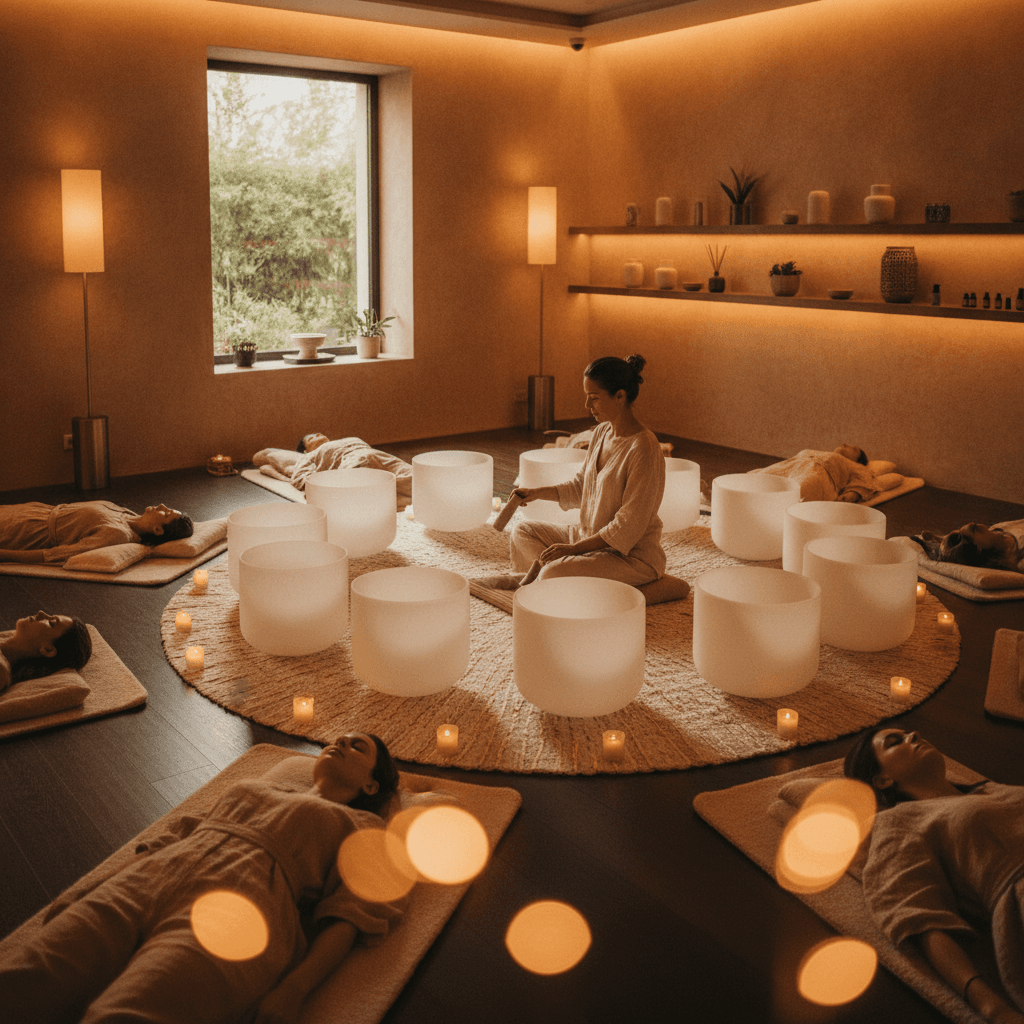
Imagine entering a serene space, free from the distractions of the outside world. You are invited to lie down comfortably, supported by cushions and blankets, allowing your body to fully relax. The session doesn't begin with a sudden crash but with a gentle, grounding tone from a crystal bowl. This initial sound acts as an anchor, drawing your awareness into the present moment and signaling to your nervous system that it is safe to unwind.
As the session progresses, layers of sound are introduced. The deep, resonant vibrations of a large gong wash over you, a physical sensation you can feel in your chest and limbs. This is not just an auditory experience; it is a full-body vibrational massage that can help release physical tension held deep within the muscles. The pure, ethereal notes of alchemy crystal singing bowls follow, their frequencies creating a soundscape that seems to quiet the incessant chatter of the mind.
For many, this is where the brainwave shift described in EEG studies becomes a tangible feeling. The constant loop of to-do lists and worries begins to fade, replaced by a sense of spaciousness and peace. It's a state that is neither sleep nor wakefulness, but a serene in-between—an altered state of consciousness where deep relaxation and mental clarity can emerge. It is this consistent, lived experience that continues to fuel both popular practice and scientific curiosity.
The Soul Art Approach: Evidence-Informed Serenity
At Soul Art, we are deeply committed to honouring both the ancient lineage of sound practices and the evolving scientific landscape. Our founder, Larissa Steinbach, has cultivated an approach that is evidence-informed, meaning we integrate the most credible findings from neuroscience and physiology to create sessions that are not only spiritually resonant but also grounded in principles that support nervous system regulation.
We recognize the limitations noted in research—such as participants being uncomfortable lying on a hard floor—and have meticulously designed our Dubai studio to be a sanctuary of comfort and quiet luxury. This ensures that your body and mind can be fully receptive to the experience, removing physical distractions that might hinder deep relaxation.
Our practice at Soul Art focuses on:
- Curated Instrumentation: We use a specific collection of gongs, alchemy crystal singing bowls, and other precision instruments chosen for their tonal purity and vibrational qualities, which are associated with encouraging the alpha and theta brainwave states linked to calm and creativity.
- Intentional Sequencing: A session is not a random collection of sounds. Larissa Steinbach designs each sound bath as a unique journey, carefully sequencing frequencies and dynamics to gently guide you into a state of deep rest and then smoothly back to wakeful awareness.
- Education and Integrity: We believe in transparency and providing our clients with a clear understanding of what sound wellness can and cannot do. We present it as a powerful tool for stress management, relaxation, and self-discovery, always in complement to, and never as a replacement for, professional medical care.
Your Next Steps: Cultivating a Sound Mind
As the science of sound continues to unfold, you don't have to wait for the final verdict to begin exploring its benefits for your own wellbeing. Integrating intentional sound into your life can be a simple yet profound act of self-care.
Here are a few practical steps you can take today:
- Listen Mindfully: Pay attention to the sounds in your everyday environment. Notice how a bustling street affects your nervous system versus the sound of birdsong. This simple awareness is the first step in understanding your personal relationship with sound.
- Curate Your Personal Soundscape: Create playlists for different moods. What music helps you focus? What sounds help you relax before sleep? Experiment with ambient sounds, classical music, or nature recordings.
- Explore Different Modalities: The world of sound wellness is diverse. Try a guided meditation with singing bowls online, explore a binaural beats track designed for focus (with headphones), or simply hum to yourself for a few minutes and notice the vibration in your chest.
- Seek Qualified Practitioners: When you're ready for a deeper experience like a sound bath, choose a practitioner who is not only skilled with their instruments but also understands the importance of creating a safe, comfortable, and supportive environment. This ensures your experience is both enjoyable and restorative.
The most powerful research you can do is to observe the effects of sound on your own system. Your direct experience is a valid and essential piece of the puzzle.
In Summary: A Resonant Future
The field of sound wellness stands on a foundation of ancient tradition, supported by a growing, albeit incomplete, body of modern scientific research. While preliminary studies show immense promise in its ability to support stress reduction, mood enhancement, and deep relaxation, the future of its credibility lies in conducting more rigorous, large-scale, and standardized research. We must move forward with both open-minded curiosity and a commitment to scientific integrity.
The convergence of intuitive wisdom and empirical data is creating a powerful new paradigm for wellbeing. At Soul Art Dubai, we are honored to be part of this evolution, offering a space where you can experience the profound potential of sound for yourself. We invite you to explore this resonant world and discover how intentional sound can become an invaluable tool in your personal wellness journey.
Bookings Coming Soon
Soul Art is still in preparation. Session details and booking will be published here after launch.
Coming Soon
Related Articles
Navigating Sound Wellness: Evidence-Based Questions for Practitioners
Soul Art: Integrating Science, Ritual, and Safety for Well-being
Sound Baths: Accessible Comfort for Older Adults at Soul Art