The Sonic Edge: How Sound Can Boost Strength & Power Output

Key Insights
Explore the surprising science of how sound—from specific frequencies to intentional vocalizations—can enhance power output in strength training. Discover how Soul Art Dubai uses this knowledge for athletic performance.
Have you ever wondered why the world’s strongest athletes often let out a powerful grunt or roar when attempting a record-breaking lift? Or why your workout feels entirely different depending on the music playing through your headphones? While many dismiss these as simple motivational tactics or habits, a growing body of scientific research suggests something far more profound is at play. The connection between sound and physical strength is not just psychological; it is deeply neurological.
This article will explore the fascinating science of how specific auditory stimuli and intentional vocalizations can directly influence your body's ability to generate force. We will unpack the studies that demonstrate tangible increases in power output and examine the physiological mechanisms responsible. More importantly, we will show you how to move beyond generic playlists and begin using sound as a precision tool to unlock new levels of performance, focus, and mind-body connection in your own strength training journey.
The Neurological Symphony of Strength and Sound
To understand how sound impacts strength, we must first appreciate that raw power is not just a function of muscle size. It is a complex interplay between your brain, your nervous system, and your muscle fibers. The ability to lift heavy weights hinges on neural adaptations—your nervous system's efficiency in communicating with your muscles. This is where sound enters the equation, acting as a powerful conductor for this internal orchestra.
Sound as a Neurological Primer
Your brain’s motor cortex is the command center for all voluntary movement. Before you even touch a barbell, this region is firing, preparing the body for action. Research suggests that certain auditory stimuli can act as a primer for this system, making it more responsive and efficient.
A pivotal study published in the Review of Psychology by Murgia and colleagues investigated this very concept. They had experienced lifters perform the bench press under two conditions: with a specific auditory stimulus and with no stimulation at all. The results were compelling.
- Increased Performance: The athletes consistently performed more repetitions when exposed to the sound stimulation compared to the silent condition.
- Direct Impact: This wasn't about motivation or distraction. The study points toward sound directly influencing the nervous system's capacity to sustain a high level of performance.
This suggests that the right sound may help optimize motor unit recruitment. Think of motor units as teams of muscle fibers that fire together. A stronger contraction involves recruiting more of these teams. Sound may act as a catalyst, allowing your brain to send clearer, stronger signals to call more of these units into action for a given lift.
The Power of Vocalization: From Grunts to Gains
The influence of sound is not limited to what we hear; it extends to the sounds we create. The primal grunt of an athlete is more than just theatrical—it’s a physiological tool. Research led by Jason Sawyer, Ph.D., at Bryant University examined the effects of grunting on power output in martial artists.
The study found that grunting significantly increased power production during explosive, full-body movements like punches and kicks. The proposed mechanism is an increase in corticospinal excitability. In simpler terms, the act of producing a low, forceful sound appears to "turn up the volume" on the communication pathway from the brain's cortex down the spinal cord to the muscles. This heightened state of neural readiness may allow for a more forceful and rapid muscular contraction.
It’s Not Just Any Noise
However, this doesn't mean that simply turning up the volume on any music will lead to a new personal best. Nuance is critical. A 2024 study by Latocha et al. found that listening to preferred music during rest intervals had no significant effect on power output during squats and bench presses. Similarly, other research has shown that simply increasing the intensity (loudness) of music doesn't necessarily correlate with better performance.
This tells us that the type, timing, and intention behind the sound are paramount. Passive listening during rest is different from focused, rhythmic stimulation during a set. The sonic environment should be a precision tool, not just background noise.
From the Lab to the Lifting Platform
Understanding the science is one thing; applying it is another. How does this translate into a real-world training session? It’s about shifting the perception of sound from a passive distraction to an active component of your performance preparation and execution.
Imagine preparing for a heavy set of deadlifts. Instead of chaotic, high-tempo music, you begin with a few moments of listening to a low-frequency, rhythmic sound. This isn't for hype; it's a wellness practice designed to ground your nervous system, filter out mental chatter, and prime the motor pathways for the powerful, coordinated effort to come. You feel your breath synchronize with the rhythm, your mind sharpens, and your focus narrows to the task at hand.
As you perform the lift, you employ a controlled, forceful exhale—not an uncontrolled scream, but a focused grunt. This act of vocalization serves multiple purposes. It helps create intra-abdominal pressure, stabilizing your core and protecting your spine. Simultaneously, as the science suggests, it may be sending a supercharged signal from your brain to your muscles, unlocking that extra bit of force needed to move the weight.
"Sound provides a direct pathway to the nervous system. We are not just distracting the mind; we are tuning the very instrument responsible for generating force—the body itself."
This intentional use of sound transforms an exercise from a purely physical act into a holistic experience. It fosters a deeper connection between mind and muscle, enhancing not only performance but also body awareness and presence during your training.
The Soul Art Method: Precision Sound for Peak Performance
At Soul Art, we harness these scientific principles to create highly specialized sound wellness experiences for athletes and individuals seeking to optimize their physical potential. Our founder, Larissa Steinbach, has developed a unique approach that goes far beyond a generic playlist. We believe that every individual has a unique resonant frequency, and our goal is to create an auditory environment that aligns with your specific training goals.
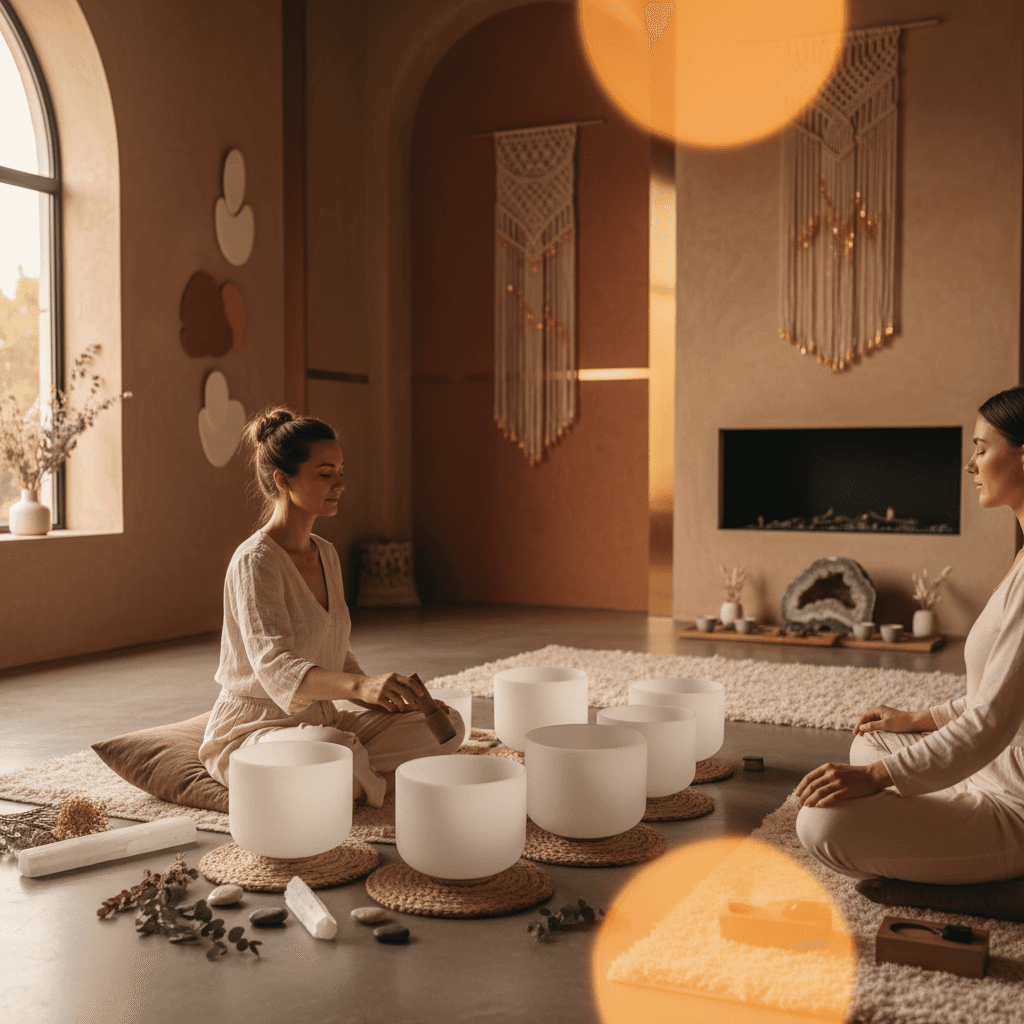
The Soul Art method is built on precision and intention. We utilize a range of therapeutic instruments, from resonant crystal bowls and gongs to specific rhythmic patterns, to support the nervous system in different states.
- For Pre-Workout Priming: We may use low-frequency sounds from our gongs to facilitate a state of grounded focus. This practice can help down-regulate an over-stimulated nervous system, allowing the athlete to approach their session with calm intensity rather than anxious energy.
- For Explosive Power: We might incorporate dynamic, rhythmic drumming patterns. The predictable, powerful rhythm can help with auditory-motor entrainment, where the brain’s motor centers synchronize with an external rhythm, potentially improving the timing and efficiency of explosive movements.
This is a proactive, complementary approach. We work with clients to build a sonic toolkit that they can integrate into their training and recovery. The work we do at Soul Art is about providing a targeted neurological support system, helping you build a more resilient, responsive, and powerful mind-body connection.
Integrating Sound Into Your Own Training
You can begin to explore the power of sound in your own fitness routine today. This is not about complex equipment but about cultivating greater awareness and intention. Here are a few practical steps to get you started:
- Mindful Listening Pre-Workout: Before your next session, take five minutes. Instead of scrolling through your phone, sit quietly and listen to a single, focused piece of instrumental music or a simple drone frequency. Notice how it affects your breathing, your heart rate, and your mental state.
- Harness Your Breath and Voice: Experiment with a powerful, audible exhale during the most difficult part of a lift (e.g., pushing up from the bottom of a squat). Focus on creating the sound from your core. Notice how it helps you brace and whether it impacts your perception of effort.
- Curate with Intention: Choose your workout music consciously. Does the tempo match the exercise you're performing? A driving, steady beat might be ideal for a heavy lifting day, while more varied rhythms might support a dynamic circuit.
- Explore Rhythmic Entrainment: For exercises like kettlebell swings or box jumps, try finding a track with a strong, clear beat that matches your desired pace. Let your body sync with the rhythm and observe the effect on your endurance and consistency.
For those ready to delve deeper, a personalized wellness session can help identify the specific frequencies and soundscapes that best support your nervous system and performance goals.
In Summary: The Untapped Variable in Your Strength Equation
The relationship between sound and strength is a legitimate, evidence-supported frontier in athletic performance and holistic wellness. The science shows that sound is not merely a background element for motivation; it is an active variable that can have a measurable impact on neurological function and physical power output.
From specific auditory stimuli that may enhance motor unit recruitment to intentional vocalizations that appear to boost corticospinal excitability, sound offers a powerful, non-invasive tool for anyone looking to break through plateaus. The key lies in shifting from passive listening to intentional application. By curating your sonic environment with purpose, you can better prepare your nervous system, execute movements with greater force, and foster a more profound mind-body connection. We invite you to explore this potential at Soul Art Dubai and discover how the right frequency can unlock your strength.
Bookings Coming Soon
Soul Art is still in preparation. Session details and booking will be published here after launch.
Coming Soon
Related Articles
Optimizing Athletic Performance: The Synergy of Sports Nutrition and Sound Wellness

Archery, Stillness, and Sound: Soul Art's Path to Focus

Swimming's Secret Weapon: Sound for Peak Aquatic Performance