Biofeedback Sound: Mastering Real-Time Well-being in Dubai
Key Insights
Explore Biofeedback Sound at Soul Art Dubai, leveraging real-time insights for enhanced relaxation, stress resilience, and holistic well-being with Larissa Steinbach.
Have you ever considered that the very sounds you create – or the subtle shifts within your own body – could become a real-time guide to profound relaxation and self-mastery? In our rapidly evolving world, the quest for inner peace often feels like an elusive whisper against the din of daily life. Yet, a revolutionary approach known as Biofeedback Sound is emerging as a powerful ally, transforming how we perceive and influence our physiological states.
At Soul Art, Dubai’s premier sound wellness studio, founded by the visionary Larissa Steinbach, we harness this cutting-edge science to offer an unparalleled journey into real-time self-awareness. This article will delve into the scientific underpinnings of biofeedback sound, illustrating how this elegant synergy of technology and ancient wisdom may support optimal well-being. Prepare to discover how immediate physiological insights, translated into harmonious soundscapes, can empower you to cultivate a more balanced and resilient existence.
The Science Explained: Unlocking Your Body's Inner Symphony
Biofeedback is a sophisticated mind-body technique that uses instrumentation to provide a real-time representation of physiological processes typically outside our conscious awareness. Imagine seeing your heartbeat as a gentle pulse of light or hearing your breath translate into a soothing melody. This immediate, objective feedback empowers individuals to learn how to adjust their bodily functions voluntarily, fostering greater control over their health and well-being.
Decades of scientific research back biofeedback therapy, demonstrating its potential to support the management of various conditions by enhancing self-regulation. It works by creating a feedback loop: sensors monitor a physiological signal, that signal is then translated into an understandable format (visual, auditory, or tactile), and the user observes this feedback to make conscious or subconscious adjustments. This iterative process allows for a deeper understanding and eventual mastery of internal states.
Understanding Biofeedback: Bridging Mind and Body
At its core, biofeedback uses technology to make the invisible visible, or in our case, the inaudible audible. Volin (1998) described biofeedback as using instrumentation to create a real-time representation of certain aspects of speech that are typically outside the speaker’s conscious control. This principle extends far beyond speech, applying to a myriad of bodily functions. The goal is always the same: to provide a tangible link between an internal state and an external sensory experience.
Various types of biofeedback exist, each focusing on different physiological markers.
- Heart Rate Variability (HRV) Biofeedback measures the variability in time intervals between heartbeats. Research in Applied Psychophysiology and Biofeedback suggests that HRV training may improve emotional regulation, potentially lower blood pressure, and enhance stress resilience by improving cardiac vagal control (neuroTree source).
- Neurofeedback (EEG Biofeedback) monitors brainwave activity, training the brain to shift into healthier patterns. Studies in NeuroRegulation have explored its use for conditions such as ADHD, PTSD, and anxiety, aiming to support the brain's natural regulatory capacities (neuroTree source).
- Temperature Biofeedback tracks skin temperature, a proxy for blood flow and stress levels. This technique often helps individuals learn to increase peripheral blood flow through relaxation, potentially supporting stress reduction and migraine relief (neuroTree source).
Our focus, however, is on the transformative power of biofeedback sound, where auditory cues become the primary interface for self-regulation.
The Auditory Advantage: Harnessing Sound for Self-Regulation
Sound holds a unique position in biofeedback, offering an immersive and often less cognitively demanding pathway to self-awareness compared to purely visual displays. In biofeedback sound, physiological data is translated into acoustic signals, providing immediate, real-time feedback that allows individuals to "hear" their internal states.
Early evidence for the efficacy of real-time acoustic feedback comes from speech therapy. Studies have shown that biofeedback-enhanced interventions may help eliminate speech sound distortions, such as the /ɹ/ sound in children (McAllister & Hitchcock, 2012; Preston et al., 2013). In visual-acoustic biofeedback (VAB) therapy, learners view a dynamic image of the acoustic signal of their speech and compare it against a target representing correct acoustics. This real-time auditory-visual coupling allows learners to modify their output to match a desired model, accelerating progress by making subtle acoustic differences perceptible (PMC11101137 source, Syracuse University source). This demonstrates the power of immediate acoustic feedback for fine-tuning complex bodily functions.
Beyond speech, audio biofeedback has shown promise in other areas of physiological control. A clinico-experimental study found that patients with degenerative cerebellar ataxia were able to use audio biofeedback (ABF) as a real-time assistive signal to compensate for deficient postural control (PMC6389757 source). They seemed to exploit auditory cues functionally similar to vision, and additively to vision in cases of pronounced postural sway. This highlights how auditory feedback can provide crucial sensory information, even when other sensory systems are impaired, enabling individuals to make real-time adjustments for improved balance and stability. The study noted that reductions in postural sway were observed only in the ABF intervention group, underscoring that the improvements were directly induced by the exploitation of the ABF, not unspecific exercise effects.
The elegance of auditory displays also lies in their ability to liberate users' eyes, allowing for integration into various activities and settings. Biofeedback data can be directly coupled to musical parameters like pitch or intervals, or modify the quality of pre-selected music in real time, creating an engaging and therapeutic experience (Frontiers source). This blend of physiological feedback with aesthetically pleasing soundscapes addresses the traditional challenge of making biofeedback engaging while maintaining its therapeutic effectiveness.
The Brain-Body Connection: Real-Time Physiological Insights
The profound impact of biofeedback sound lies in its ability to foster a deeper connection between the brain and body. Our autonomic nervous system, responsible for unconscious bodily functions like heart rate, breathing, and digestion, constantly responds to our environment and internal states. Chronic stress can throw this system out of balance, leading to a cascade of physiological and psychological challenges.
Biofeedback sound provides a direct pathway to influence this balance. By monitoring markers like Heart Rate Variability (HRV), which is a key indicator of autonomic nervous system balance, systems can dynamically generate or modulate ambient music. Clinical studies reveal that HRV-guided ambient music therapy may produce measurable improvements in cardiac vagal control within single sessions (ambientspacesradio source). Research has found that higher-frequency ambient music, specifically in the 1000-16000 Hz range, produced significant increases in RR intervals and sample entropy indicators, suggesting enhanced cardiac regulation and system complexity. The integration of biofeedback ensures these therapeutic frequencies are delivered precisely when physiological markers indicate optimal receptivity.
The dynamic interplay between sound and physiology creates a powerful feedback loop. As your body moves towards a more relaxed state – perhaps your breathing deepens, or your heart rate steadies – the soundscape around you subtly responds, becoming more harmonious, expansive, or calming. This immediate auditory affirmation reinforces positive physiological changes, making the process of self-regulation intuitive and enjoyable. A landmark study examining the “UnWind” musical biofeedback system found significant interaction effects between music and biofeedback on HRV improvement, with participants experiencing enhanced parasympathetic activation and reduced anxiety when nature sounds and sedative music were dynamically modulated based on physiological feedback (ambientspacesradio source). This clearly demonstrates that biofeedback-controlled musical interventions may produce superior therapeutic outcomes compared to passive music listening alone.
How It Works in Practice: Experiencing the Sonic Mirror
Moving from scientific principle to practical application, the experience of biofeedback sound is both deeply personal and profoundly illuminating. It’s not merely about listening to soothing sounds; it’s about engaging in an active dialogue with your own body, mediated by the transformative power of sound. This practice offers a unique opportunity to cultivate a heightened sense of interoception – the awareness of your internal bodily states.
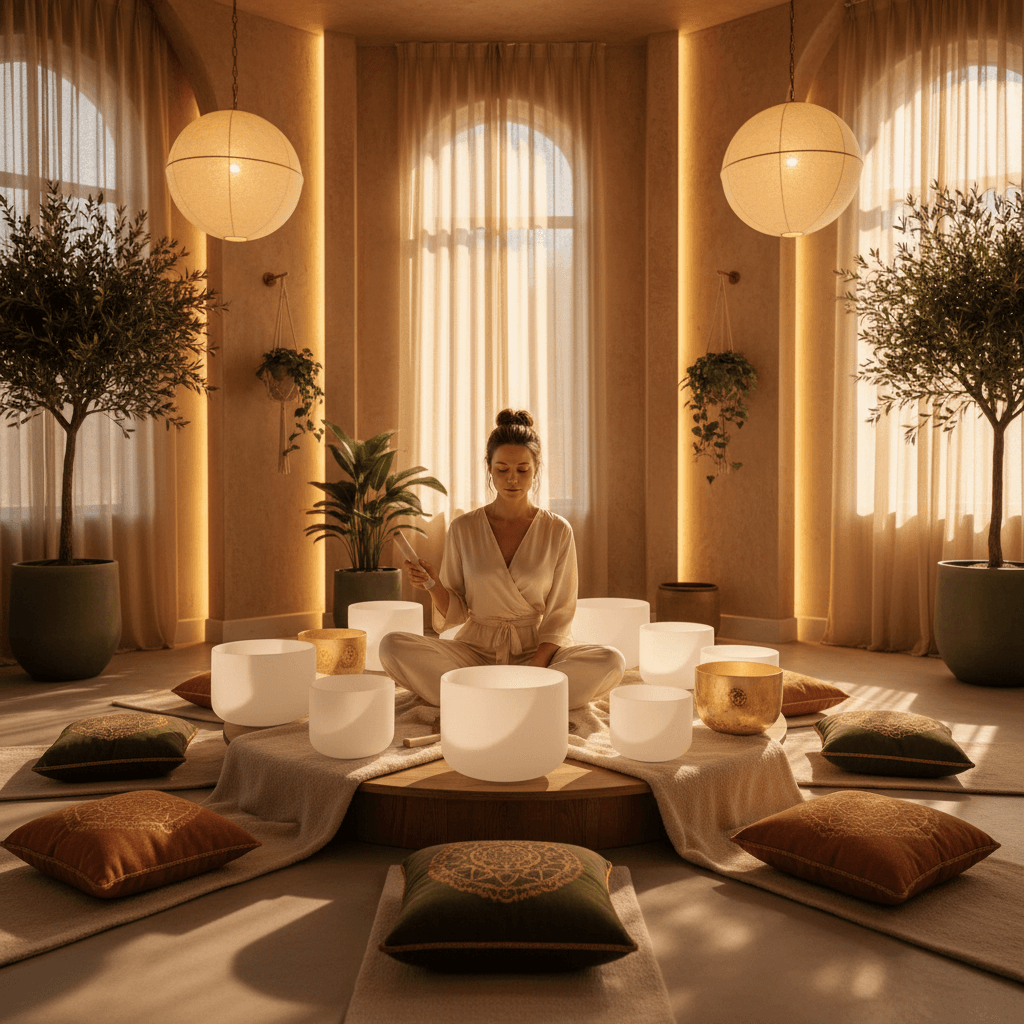
Imagine stepping into a serene space at Soul Art, where the ambiance itself invites tranquility. You are gently guided to settle in, and subtle sensors are placed on your body – perhaps on your fingertips or around your wrist – to unobtrusively monitor key physiological signals. These might include your heart rate, skin conductance, or breath patterns. As these sensors begin to gather your real-time data, the magic of biofeedback sound comes alive.
The studio's advanced sound system begins to play a nuanced soundscape, a carefully curated composition that is not static, but fluid and responsive. What you hear is not simply a pre-recorded track, but an auditory reflection of your inner world. If your nervous system is in a heightened state, the soundscape might present with subtle dissonances, faster tempos, or more intense frequencies. However, as you begin to engage in conscious relaxation techniques – perhaps deepening your breath or softening your muscles – the soundscape dynamically shifts.
"The real-time auditory feedback acts as a sonic mirror, reflecting your internal state back to you with exquisite precision. It allows you to 'hear' your nervous system settling, guiding you gently towards balance."
You might notice the rhythms becoming smoother, the harmonies richer, the frequencies more resonant and expansive. This immediate, palpable shift in the soundscape provides powerful, intuitive feedback. You don't need to interpret complex graphs or numbers; your body simply feels and hears the change. This direct correlation between your internal state and the external sound makes the process of self-regulation much more accessible and tangible. It transforms what could be a challenging internal struggle into a fascinating journey of discovery.
The beauty of this real-time response lies in its ability to bypass intellectual analysis and tap directly into your sensory experience. It empowers you to refine your relaxation techniques, offering instant validation when you achieve a desired physiological shift. You learn which thoughts, breathing patterns, or subtle physical adjustments lead to a more harmonious internal state, as evidenced by the evolving sound. This creates a powerful learning loop, helping you internalize these regulatory skills for use in your daily life. It’s a sensory bridge connecting your conscious intentions with your unconscious physiological responses, fostering a deeper, more profound sense of embodied presence and control.
The Soul Art Approach: Larissa Steinbach's Vision for Sonic Well-being
At Soul Art, Larissa Steinbach has meticulously crafted an experience that marries the ancient wisdom of sound healing with the innovative science of biofeedback. Her vision extends beyond passive listening, inviting clients into an active, transformative engagement with their own well-being. The Soul Art approach is not merely about relaxation; it's about empowerment through enhanced self-awareness and self-regulation, using the unique language of sound.
Larissa Steinbach, with her deep understanding of vibrational wellness, integrates biofeedback sound as a cornerstone of her studio's offerings. She recognized that while traditional sound baths are incredibly potent for relaxation, the addition of real-time physiological feedback could elevate the experience to a new level of personalized efficacy. This bespoke synergy allows for a truly adaptive session, where the sound environment is not static but dynamically responsive to the individual's unique needs in that moment.
What makes the Soul Art method truly unique is its thoughtful integration of high-fidelity sound technology with a holistic, client-centered philosophy. While other studios might offer either traditional sound baths or general biofeedback, Soul Art specifically focuses on the convergence of these two powerful modalities, tailored for profound wellness. Larissa and her team utilize sophisticated biofeedback sensors that capture a range of physiological data, including Heart Rate Variability (HRV), skin conductance, and breath patterns. This data is then meticulously translated into a responsive soundscape.
Soul Art employs a diverse array of instruments and digital soundscapes, all engineered to respond in real-time to the client's internal state. This might involve:
- Generative Ambient Soundscapes: Custom-designed algorithms that create evolving, harmonious music based on physiological data, ensuring the sound directly reflects and influences the body's state.
- Responsive Sonic Textures: Integrating subtle shifts in frequency, timbre, and rhythm from instruments like crystal singing bowls, gongs, and chimes. For instance, as a client's heart rate steadies, the sonic textures might become smoother and more sustained, fostering deeper relaxation.
- Personalized Frequency Modulation: Utilizing specific frequency ranges known to support parasympathetic activation, dynamically introduced when physiological markers indicate optimal receptivity. Research suggests that higher-frequency ambient music, in the 1000-16000 Hz range, can be particularly effective in enhancing cardiac regulation (ambientspacesradio source).
The aim is to create an immersive, intuitive experience where the client learns to influence their own physiology through the immediate feedback of sound. This active engagement transforms passive reception into an empowering journey of self-discovery and conscious regulation. For the discerning clientele in Dubai, Larissa Steinbach offers a sophisticated, evidence-informed pathway to navigate the demands of modern life with greater ease and inner harmony, providing a sanctuary where science meets soul in perfect resonance.
Your Next Steps: Cultivating Real-Time Well-being
Embracing the potential of biofeedback sound is a journey towards greater self-awareness and resilience. While the advanced technology at Soul Art provides an unparalleled experience, there are foundational practices you can begin to integrate into your daily life to cultivate a stronger mind-body connection. These simple yet powerful steps can lay the groundwork for enhanced well-being and prepare you to fully appreciate the real-time insights offered by biofeedback sound.
Here are a few actionable steps you can take today:
- Practice Mindful Breathing: Your breath is a direct link to your autonomic nervous system. Take a few moments each day to consciously observe your breath without judgment. Focus on slow, deep inhales that expand your belly and long, gentle exhales. This simple practice may support parasympathetic activation and calm the nervous system.
- Tune into Your Body's Subtle Cues: Throughout your day, pause and check in with your physical sensations. Notice areas of tension, your heart rate, or your overall energy levels. Cultivating this interoceptive awareness is the first step towards self-regulation, as it helps you recognize when you might benefit from a moment of pause or a shift in focus.
- Explore Intentional Soundscapes: Experiment with different types of music or ambient sounds that genuinely resonate with you and evoke feelings of calm or focus. While not biofeedback-driven, consciously choosing sounds that support your desired state can be a powerful self-care practice.
- Prioritize Moments of Quiet Reflection: In our busy lives, carving out time for stillness is crucial. Whether it's five minutes of meditation, journaling, or simply sitting in silence, these moments allow your nervous system to reset and process, enhancing your receptivity to internal signals.
- Consider a Guided Biofeedback Sound Session: To truly experience the transformative power of real-time auditory feedback, exploring a session at a dedicated studio like Soul Art can be profoundly beneficial. Under expert guidance, you'll learn to actively influence your physiological state through responsive sound, accelerating your journey towards deeper self-regulation and peace.
These practices, when consistently applied, can significantly enhance your ability to navigate stress and cultivate a more balanced existence. They are complementary approaches that synergize beautifully with advanced wellness practices like biofeedback sound, guiding you towards a state of profound calm and clarity.
In Summary: Harmonizing Your Inner Landscape
Biofeedback sound represents a sophisticated frontier in wellness, offering a powerful method for self-regulation and stress management. By translating subtle physiological data into real-time auditory feedback, it empowers individuals to consciously influence their body's responses, fostering a deeper connection between mind and body. This scientifically-grounded approach may support improvements in autonomic nervous system balance, enhance stress resilience, and cultivate overall psychological well-being.
At Soul Art, Larissa Steinbach masterfully integrates this innovative science with a profound understanding of sound's therapeutic potential. Through personalized, dynamic soundscapes that respond to your unique internal state, Soul Art offers an immersive experience designed to guide you towards deeper relaxation and self-mastery. It’s an invitation to harmonize your inner landscape and unlock a new dimension of vibrant living. Discover how real-time response can lead to real-time transformation.
Bookings Coming Soon
Soul Art is still in preparation. Session details and booking will be published here after launch.
Coming Soon
Wellness Disclaimer: This article is for educational and informational purposes only. It does not constitute medical advice, diagnosis, or treatment. Soul Art Dubai provides non-medical wellness experiences focused on relaxation, stress management, and general wellbeing. Sound wellness is a complementary practice and should not replace professional medical care.
Related Articles
Unseen Ears: Unpacking Voice-Activated Sound & Your Wellbeing
Precision Resonance: Digital Audio Workstations for Healing
Spectrum Analyzers: Unveiling the Science of Sound for Wellness